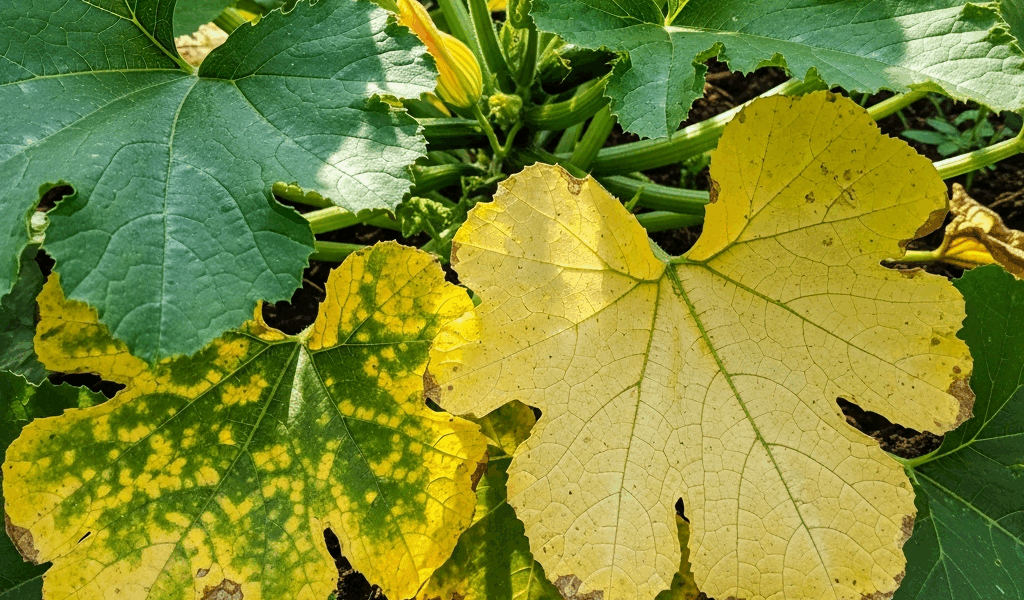
Zucchini leaves turn yellow for several different reasons, and the pattern is the fastest way to narrow them down. One or two old lower leaves may simply be aging. Yellowing throughout the plant can point to saturated roots or a nutrient problem. Fine pale speckles suggest sap-feeding mites, white patches suggest powdery mildew, and sudden wilting with sawdust-like material at the stem base is a warning sign for squash vine borer.
Do not fertilize or spray first and diagnose later. Check which leaves changed, inspect both leaf surfaces and the stem base, and test the soil moisture. The steps below help distinguish the common causes of yellow zucchini or courgette leaves without relying on a one-size-fits-all remedy.
Quick diagnosis: match the yellowing pattern
| What you see | Likely explanation | What to check next |
|---|---|---|
| Only the oldest bottom leaves are evenly yellow | Normal aging, especially if new growth and fruit look healthy | Watch for spread; remove a leaf only when it is mostly dead or diseased |
| Many leaves are pale and growth is weak | Root stress, low nitrogen, or another soil problem | Check moisture and drainage first; use a soil test before adding nutrients |
| Yellow tissue between greener veins | Possible nutrient availability problem | Test soil pH and nutrients rather than assuming magnesium deficiency |
| Fine yellow or pale dots, often with webbing underneath | Spider mites | Inspect leaf undersides with a hand lens or tap a leaf over white paper |
| White, powdery patches that expand on older leaves | Powdery mildew | Confirm actual white fungal growth; normal silver leaf markings do not rub off |
| Mottled light and dark green, distorted leaves, stunting | Possible mosaic virus | Compare several leaves and rule out mite damage or nutrient stress |
| Plant wilts or collapses; hole and tan/orange frass at stem base | Squash vine borer | Inspect the crown and lower stem immediately |
When yellow lower leaves are normal
An established zucchini plant may shed its oldest shaded leaves as it puts energy into newer growth and fruit. Normal aging usually begins with one or two leaves near the base. The rest of the plant remains vigorous, the stem is firm, and the yellowing does not race upward.
Do not strip off healthy foliage just to make the plant look tidy. Leaves power growth and shade developing fruit. If a lower leaf is mostly dead, badly diseased, or lying on wet soil, cut its petiole with clean pruners without damaging the main stem. Disinfect the tool before using it on another plant when disease may be present.
Check water and roots before adding fertilizer
Both prolonged saturation and severe drought can leave zucchini pale, wilted, or yellow. The confusing part is that a waterlogged plant may wilt even though the soil is wet: damaged, oxygen-starved roots cannot supply the canopy normally.
- Push a finger or narrow trowel several inches into the soil just outside the root crown.
- If the root zone is wet and sticky, pause irrigation and let it drain. Look for runoff collecting around the plant, a blocked container hole, or dense compacted soil.
- If it is dry at root depth, water slowly and deeply at soil level. Recheck rather than following a fixed daily schedule.
- Keep water off the foliage when practical and avoid repeatedly wetting only the soil surface.
Do not dig perlite or large amounts of amendment around the roots of a growing plant; that can damage them. Correct chronic drainage problems between crops with raised beds, organic matter suited to the site, or a different planting location. Our guides to watering a vegetable garden and building and testing garden soil explain those preventive steps.
Could yellow zucchini leaves mean a nutrient deficiency?
They can, but leaf color alone does not identify the missing nutrient. Nitrogen shortage commonly produces general paleness that begins on older leaves because nitrogen can be moved to new growth. Interveinal chlorosis—yellow tissue between greener veins—can have several causes, including nutrient availability, root injury, and soil pH outside the crop’s useful range.
First correct excessive or insufficient water, because unhealthy roots cannot take up nutrients efficiently. Then use a soil test from a university or accredited laboratory. Follow the report and the fertilizer label for the crop and bed size. Adding Epsom salt without evidence of magnesium deficiency can add unnecessary salts and does not correct poor drainage, root disease, unsuitable pH, or nitrogen deficiency. Likewise, repeated high-nitrogen feeding can produce excessive foliage and does not solve insect or disease damage. See our fertilizer and soil-test guide before feeding.
Spider mites: tiny pale dots and webbing
Spider mites remove plant contents from individual cells, leaving many small pale or yellow speckles. Damage may merge into bronzing or yellowing, and fine silk can appear under leaves or between leaf parts. Mites often become troublesome in hot, dry, dusty conditions.
Examine the undersides of several leaves. A hand lens helps; another method is to tap foliage over white paper and look for moving dots. If mites are confirmed, reduce dust and water stress, and use a firm stream of water to dislodge them from leaf undersides where appropriate. Avoid broad-spectrum insecticides that kill mite predators and can make outbreaks worse. If further control is needed, choose a product labeled for spider mites on edible squash, cover leaf undersides, follow the label, and observe the harvest interval. The University of Minnesota Extension spider-mite guide provides identification and management details.
Powdery mildew: confirm white fungal growth
Powdery mildew begins as white, powdery spots that enlarge across leaves and stems. Infected foliage may then yellow, brown, and die. It commonly appears later in the season, and dense growth can favor disease development.
Do not confuse mildew with the natural pale or silver markings found on leaves of some zucchini varieties. Varietal markings follow the leaf pattern and do not develop a powdery surface. Once mildew is present, remove severely affected debris, improve spacing and airflow, avoid unnecessary overhead irrigation, and use only a fungicide labeled for powdery mildew on edible cucurbits. Preventive products work better than attempts to reverse heavily infected leaves. Avoid improvised dish-soap or baking-soda mixes, which can injure foliage and are difficult to dose consistently. See the University of Minnesota Extension powdery mildew guide for symptoms and control options.
Squash vine borer: yellowing plus sudden wilt
A squash vine borer larva feeds inside the stem, disrupting water movement. The strongest clues are sudden wilting, a weakened lower stem, and moist tan or orange, sawdust-like frass near an entry hole. A drought-stressed plant may recover overnight; a borer-damaged plant often continues to decline.
Inspect the crown and lower stem rather than treating the leaves. Once larvae are inside, foliar insecticide will not reach them. Some gardeners carefully slit a stem to remove a larva and then cover the wounded section with soil, but this can further injure the plant and is not guaranteed to work. Prevention is more dependable: monitor for adults and eggs, use row cover only before flowering and where crop rotation prevents trapping emerged moths, and remove cover when blossoms need pollination. Read the University of Minnesota Extension squash vine borer guide and our guide to preventing squash vine borer damage.
Mosaic viruses and other diseases
A mosaic pattern is irregular rather than uniformly yellow: light and dark green or yellow areas occur together, often with puckering, narrow or distorted leaves, stunting, or misshapen fruit. Several viruses can affect squash, and symptoms can resemble herbicide injury, mites, or nutrient problems.
There is no spray that cures a virus-infected zucchini. Do not compost a plant suspected of a viral disease next to the crop, and control weeds that may host viruses. Because diagnosis from a photograph is unreliable, send clear photos or a sample to your local Cooperative Extension office or plant diagnostic laboratory before removing multiple plants. Wash tools and hands after handling a suspect plant.
What to do today
- Map the pattern: old leaves only, whole plant, between veins, fine dots, white patches, or mottling.
- Check the root zone: determine whether it is actually wet or dry several inches down.
- Inspect closely: examine leaf undersides and the stem base for mites, webbing, holes, or frass.
- Correct the confirmed cause: change irrigation, test soil, or use a crop-labeled treatment only after identifying the problem.
- Recheck new growth: damaged yellow leaves may not turn green again. Improvement is shown by healthy new leaves and the problem no longer spreading.
If the plant is still producing healthy new growth and only a couple of old leaves are yellow, monitor it rather than applying several remedies at once. If yellowing spreads quickly, the stem softens, the plant collapses, or multiple plants develop mottled distorted growth, contact your local Extension office for diagnosis.
Frequently asked questions
Should I cut yellow leaves off a zucchini plant?
Remove a leaf when it is mostly dead, badly diseased, or resting on wet soil. Keep healthy and partly functional leaves when possible. Cut the petiole cleanly without injuring the main stem, and sanitize tools if disease is suspected.
Will yellow zucchini leaves turn green again?
Often they will not. Judge recovery by healthy new growth and by yellowing that stops spreading. Correcting water or nutrition prevents additional damage; it does not necessarily restore old leaf tissue.
Does Epsom salt fix yellow zucchini leaves?
Only when a genuine magnesium shortage is responsible, which should be supported by a soil or tissue test. Epsom salt will not fix root saturation, drought, nitrogen deficiency, insects, vine borers, powdery mildew, or viruses.
Why are zucchini seedlings turning yellow?
Seedlings commonly yellow from saturated seed-starting mix, insufficient light, root damage, cold stress, or depleted mix after their first true leaves develop. Confirm moisture and light first, then use a dilute seedling fertilizer only as its label directs. Cotyledons—the first smooth seed leaves—naturally yellow and fall after true leaves take over.


Stay in the loop
Get the latest the gardening nook updates delivered to your inbox.