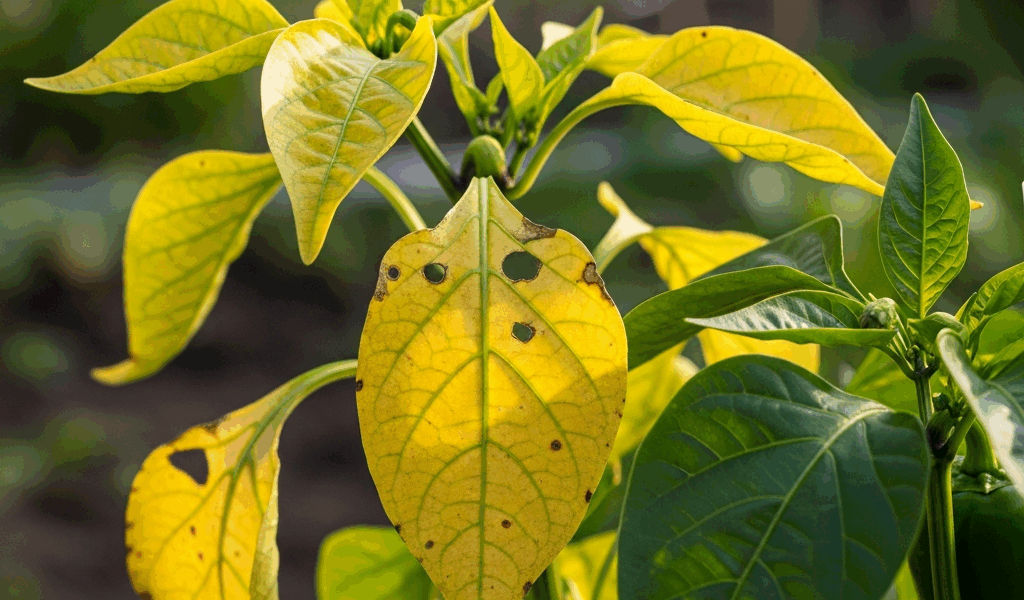
Why Pepper Leaves Turn Yellow
Pepper plant yellowing has gotten complicated with all the conflicting advice flying around. Some forums say it’s always a disease. Others blame overwatering for everything. The truth? Yellowing is just a symptom — not a diagnosis. Your plant is flagging something: a nutrient problem, a watering issue, pests, or honestly, just old age doing its thing.
As someone who killed half a pepper row in a single week, I learned everything there is to know about yellow leaves the hard way. That was five years ago — 12 plants, pale overnight, and me convinced I’d contracted some exotic garden plague. Turned out to be underwatering plus nitrogen hunger. Two weeks and a bottle of fertilizer later, problem solved. Today, I will share it all with you.
Start with the pattern. Where exactly are the yellow leaves sitting? Bottom of the plant? Scattered everywhere? Coming in with spots or weird streaking? The location tells you almost everything before you spend a dime on treatments you don’t actually need.
Bottom Leaves Yellowing First
Yellow concentrated on the lowest branches while the top looks perfectly green — that narrows things down fast. You’re looking at two possibilities: nitrogen deficiency or the plant just doing what plants do.
Natural leaf drop — the reassuring diagnosis
But what is natural senescence, exactly? In essence, it’s the plant voluntarily shedding its oldest leaves to redirect energy toward fruit and new growth. But it’s much more than that — it’s actually a sign your pepper is prioritizing correctly. If the bottom 20% is yellowing, the rest looks vibrant, and you’ve got flowers or fruit forming, nothing is wrong. The leaf drops on its own within a week or two. Walk away.
Nitrogen deficiency — the most common fix
Nitrogen deficiency looks almost identical at first glance, with one telling difference: it moves. You’ll see yellow start at the bottom leaves, then creep upward along the stem over several days. The color is uniformly washed-out pale yellow — not dark green at the veins, just ghostly all the way through.
Peppers burn through nitrogen fast, especially mid-season when they’re flowering hard. Standard potting soil runs out around the two-month mark. No supplemental feeding after that? Nitrogen deficiency is almost certainly your problem.
Probably should have opened with this section, honestly. I reach for fertilizer first because it works so reliably. I use Miracle-Gro All Purpose 24-8-16, applied every 7–10 days at half strength — about a teaspoon per gallon of water. Liquid fertilizer moves faster than granular if you want results in days rather than weeks. New growth should come in dark green within 10–14 days if nitrogen was the culprit.
Yellow Leaves Across the Whole Plant
Uniform yellowing that hits the whole plant at once — not just the bottom — usually means something is wrong underground. That’s what makes root-level problems so frustrating to us gardeners: everything looks wrong but the evidence is hidden.
Overwatering and root rot
Peppers genuinely hate sitting in wet soil. Overwatered roots essentially drown — they stop delivering water and nutrients even while surrounded by moisture. The plant reads this as severe drought and yellows everywhere at once. Counterintuitive, but that’s what’s happening.
Stick your finger two inches into the soil. Soggy? Sour smell? That’s your answer. Containers need drainage holes — non-negotiable, full stop. In-ground plants might just be sitting in a low spot that pools after rain.
Stop watering and let things dry out. Potted peppers should reach slightly moist between waterings, not wet. If you suspect root rot has already set in, repot into fresh dry mix and trim away any blackened or mushy roots with clean scissors — I use a $6 pair of Fiskars micro-tip snips I bought at Home Depot years ago and they still work fine.
Magnesium deficiency — the secondary cause
Less dramatic than root rot but worth knowing: magnesium deficiency shows as yellowing between the leaf veins while the veins themselves stay green. Appears on older leaves first, then spreads. So, without further ado, the fix is embarrassingly simple — dissolve one tablespoon of Epsom salt into a gallon of water and apply it to the soil at the base of the plant. Repeat in two weeks if needed.
I’m apparently magnesium-deficient in my entire raised bed and Epsom salt works for me while straight fertilizer never fully solved it. The 1-pound box at CVS runs about $2.50. Don’t make my mistake of buying the fancy garden version — it’s the same thing at three times the price.
Patchy or Spotted Yellow Leaves
Spots, patches, irregular blotches — that’s a different category entirely. Uniform yellowing points to nutrients or water. Patchy yellowing with marks usually means something is living on your plant. Flip the leaf over before doing anything else.
Spider mites
Tiny stippled speckling on the leaf surface. Fine webbing on the undersides, especially near the stem. Spider mites are almost invisible individually, but their damage pattern is unmistakable — leaves look dusty and pocked, then start yellowing in irregular patches as the mites drain the cells dry.
Spray the undersides of affected leaves with insecticidal soap — I use Bonide Insecticidal Soap Concentrate mixed at about 2 tablespoons per gallon. Coat the undersides completely, because that’s where they live. Repeat every seven days for three full applications. Spider mites multiply fast in dry conditions, so misting the plant lightly in the morning disrupts their preferred environment.
Aphids
Soft-bodied, pear-shaped, clustered on new growth and leaf undersides. Sometimes green, sometimes black, sometimes an unsettling pale yellow. They leave sticky honeydew residue on leaves below them. That’s what makes aphid infestations endearing to us gardeners — they announce themselves with evidence.
First, you should try a hard blast from the garden hose — at least if you catch them early. It dislodges most of a colony in one pass. For persistent infestations, insecticidal soap every three to four days handles it within two weeks for most home gardeners.
Bacterial leaf spot
Dark, water-soaked spots ringed with yellow halos. They start small and expand. Appear on both sides of the leaf. Bacterial leaf spot might be the most manageable disease option, as treatment requires only containment rather than chemicals. That is because there’s no cure for bacterial infection — the goal is preventing it from jumping to healthy foliage.
Remove every visibly infected leaf. Bag them and put them in the trash, not the compost bin. Switch to ground-level watering so leaves stay dry. The plant slows down but survives, and most gardeners see spread halt within two to three weeks of consistent removal.
How to Fix It and Keep Leaves Healthy
Here’s the quick-reference summary for diagnosis and action:
- Bottom leaves only, upper plant healthy: Check if fruit is setting. If yes, probably natural senescence — no action needed. If no, feed with balanced fertilizer every 7–10 days.
- Uniform yellowing all over: Check soil moisture first. Let it dry out between waterings. If soil moisture looks fine, apply Epsom salt solution — one tablespoon per gallon, directly to the base.
- Spotted or patchy yellow: Inspect undersides of leaves immediately. Treat for spider mites or aphids with insecticidal soap, or remove infected leaves if bacterial spot is present.
While you won’t need a full spray arsenal or a soil lab, you will need a handful of basics: a balanced liquid fertilizer, Epsom salt, insecticidal soap, and a consistent watering schedule. Three habits prevent most yellowing problems — water on a schedule rather than whenever you remember, feed every two weeks once flowering starts, and space plants far enough apart that air actually moves between them. Those three things alone eliminate roughly 80% of pepper yellowing issues before they start.
Pepper plants are genuinely tough. Most yellowing turns around fast once you address the actual cause rather than throwing random fixes at it. You just have to read what the plant is telling you.
If yellowing also includes curled or distorted growth, use our pepper leaf-curl diagnosis guide to separate watering stress, aphids, mites, edema, herbicide injury, and virus clues.

Stay in the loop
Get the latest the gardening nook updates delivered to your inbox.