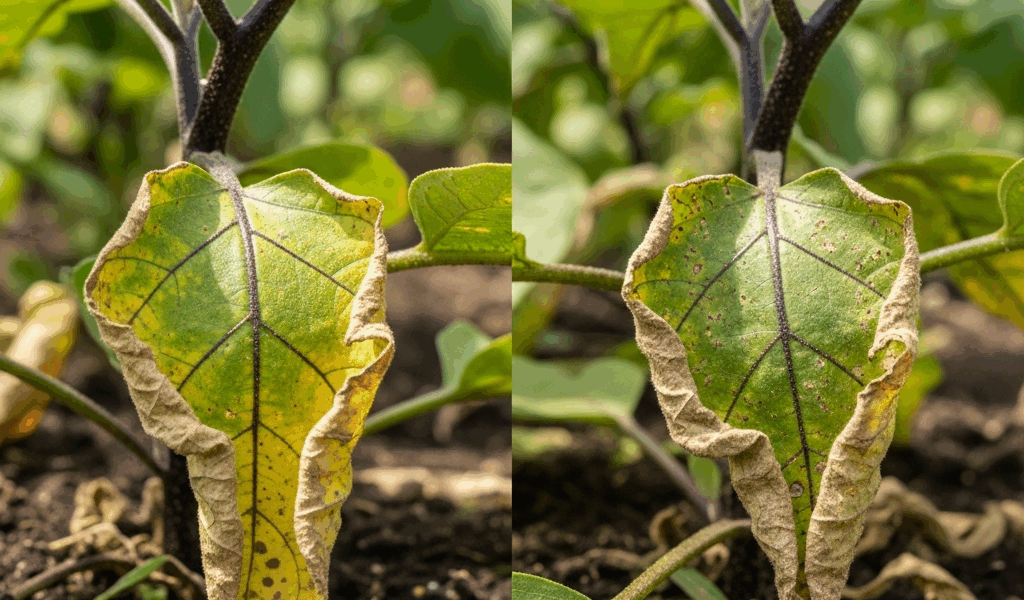
Why Eggplant Leaves Curl Upward
Eggplant leaf curl has gotten complicated with all the conflicting advice flying around. Heat stress, pests, soggy roots, disease — they all look eerily similar at first glance, and most guides just throw a checklist at you without helping you actually tell them apart. As someone who has killed more eggplants than I care to admit before finally figuring this out, I learned everything there is to know about what makes these leaves twist and cup upward. Today, I will share it all with you.
Heat Stress and Underwatering
This one is responsible for most curling cases I’ve seen — and experienced firsthand every August without fail. The leaves roll inward and upward, sometimes so tightly they look like little cigars. That’s what makes this stress response endearing to us gardeners, honestly: the plant is doing something deliberate. It’s cutting surface area to hold onto whatever water it has left.
But what is heat-triggered curl, exactly? In essence, it’s a survival mechanism. But it’s much more than that — it’s also your clearest early warning before real damage sets in.
Here’s the pattern to watch. Hot afternoon: leaves curl. Cool morning: leaves flatten back out. That daily cycle repeating itself means your eggplant is thirsty. Check the soil — the ground cracks in a spider-web pattern, or the mix pulls away from pot edges entirely. Stick your finger two inches down. Bone-dry. There’s your answer.
Fixing this takes three things. First, water deeper and less frequently — at least if you’ve been doing the light daily sprinkle routine. Soak the root zone thoroughly two or three times a week instead. I run a soaker hose on a 45-minute timer, which delivers roughly 1.5 inches per session right where the roots actually are. Second, lay 2–3 inches of mulch around the base, leaving a small gap right at the stem itself. That alone dropped my soil temperature noticeably and cut my watering by about a third. Third, shade cloth. A 30% cloth — the kind garden centers sell for $12 to $18 — draped over the plant from noon to around 4 p.m. makes a real difference once temperatures push past 95°F regularly.
To check moisture without overthinking it: finger into the soil beside the plant, not at the stem. Feel moisture at the second knuckle? You’re good. Completely dry? Water. That’s the whole system.
Aphid or Mite Infestation
Probably should have opened with this section, honestly. I spent an entire weekend in late July adjusting my watering schedule — soaking, mulching, even rigging up a shade cloth — before I finally flipped a leaf over and found the actual problem crawling around in there. Insects.
Two pests cause upward curl on eggplant specifically. Aphids are small, soft-bodied, and slow-moving — usually green or black — clustered on the undersides of leaves like tiny uninvited colonies. The curled leaf cups inward around them. You’ll also spot honeydew: a sticky film left on leaf surfaces and stems. Frustratingly gross once you know what you’re looking at.
Spider mites cause a different kind of damage. These are tinier than aphids — you need decent light or a magnifying glass — and they spin fine webbing between stems and leaves. Before the curl even develops, the leaf surface looks stippled and bleached, almost like someone dusted it with pale dots. Both pests feed on plant juices. That breaks down leaf tissue until it curls upward and stays that way, regardless of how much water you give it.
Treatment works fast once you’ve correctly identified what you’re dealing with. For aphids, I spray Monterey Neem Oil — around $10 a quart — diluted to label specs, focusing hard on leaf undersides. Insecticidal soap works too and kills on contact without leaving that distinctive neem smell everywhere. For spider mites, neem oil is still effective, but you need to apply it every five to seven days for two full weeks. Mites reproduce fast. I’m apparently sensitive to chemical sprays, and plain water at strong pressure works for me while chemical-only approaches never seem to knock back a full infestation alone. Don’t make my mistake of treating once and assuming you’re done.
The key difference from heat stress: the curl doesn’t go away overnight. Cool morning, well-watered soil, 65°F — leaves still curled. That persistence is your signal. Watering won’t fix tissue damage.
Overwatering and Root Problems
Waterlogged soil suffocates roots. That cuts off nutrient uptake, and the plant responds by curling leaves upward — usually alongside yellowing foliage or soft, mushy stem tissue near the base.
But what is overwatering curl, really? In essence, it’s the same distress signal as drought curl. But it’s much more than that — the underlying cause is completely opposite, which is why people keep making it worse by watering more.
The distinguishing detail matters here. Overwatering curl persists all day, including cool mornings. Heat stress curl relaxes when temperatures drop. Curled leaves at 8 a.m. on a 65°F morning? That’s not underwatering. The plant also looks tired overall — stunted, pale, yellowing even though the soil is saturated. One struggling hot afternoon looks different from a plant that just never looks right.
The fix requires patience more than anything else. Pull back on watering frequency. Let soil dry out slightly between sessions — not bone-dry, but definitely not soaked. Check drainage holes in pots; if water sits in a saucer for more than an hour after watering, drill additional holes or repot into something with better drainage. For in-ground plants in heavy clay, work in compost or coarse sand to open up the structure. Recovery takes time — a week or two, sometimes more, before curling stops as roots rebuild.
Viral Disease or Herbicide Drift
Less common, but worth knowing. Tomato yellow leaf curl virus — TYLCV — and similar mosaic viruses cause upward curl that never responds to watering adjustments, pest treatment, or anything else. The curl pattern tends to be irregular and asymmetrical. Growth stalls badly. The plant never looks healthy, even when conditions are perfect. That chronic, worsening decline is the tell.
Frustrated by watching a healthy-looking plant deteriorate over weeks with no obvious cause, a lot of gardeners just keep adjusting care variables using trial and error and basic intuition. That new idea of “maybe water less” or “maybe more fertilizer” eventually dead-ends. This new reality of viral infection took researchers decades to map and eventually evolved into the clear removal protocol enthusiasts know and follow today: pull the plant, throw it in the trash — not the compost — and control whiteflies on everything else nearby, since that’s how the virus spreads.
Herbicide drift is a different problem entirely. Weedkiller used on a nearby lawn, sidewalk, or neighboring property can carry on the wind and land on your eggplants. The damage looks twisted and cupped — oddly shaped, not uniform. Other plants in the area often show it too. While you won’t need to treat the eggplant chemically, you will need a handful of weeks and patience to see whether the plant recovers on its own. Mild drift sometimes resolves. Heavy exposure usually doesn’t.
Prevention beats treatment here every time. Row covers early in the season exclude whiteflies before they can transmit anything. Never spray herbicides near food gardens on windy days. And remove anything showing viral symptoms immediately — at least if you want to protect the rest of what you’re growing.


Stay in the loop
Get the latest the gardening nook updates delivered to your inbox.