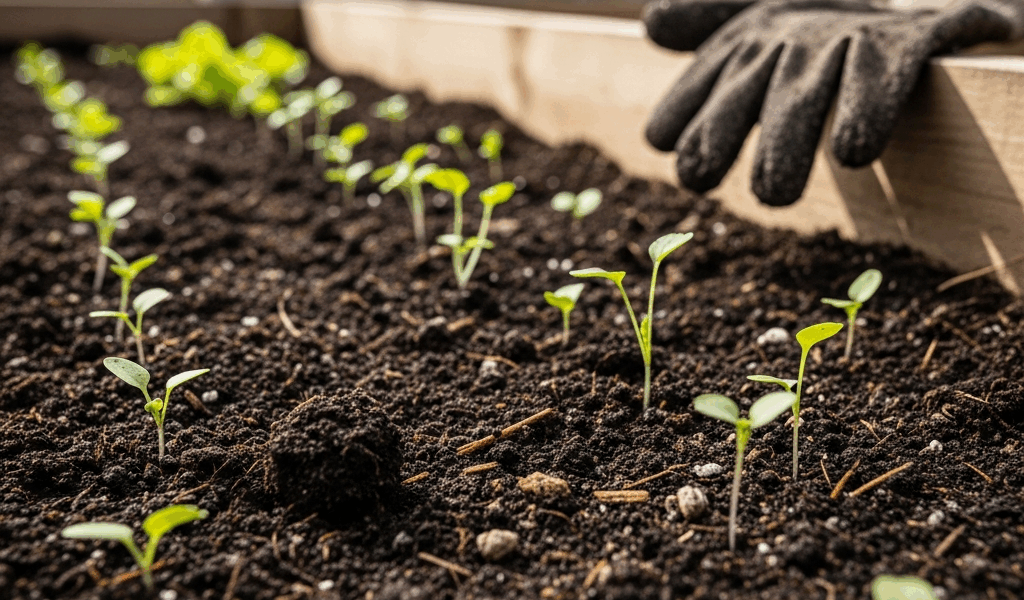
Best Raised Bed Soil Mix — The Recipe That Actually Grows Vegetables
Raised bed soil has gotten complicated with all the conflicting advice flying around. Walk into any garden center, scroll through five minutes of YouTube, and you’ll find someone swearing by a completely different recipe than the last person. I killed an entire 4×8 bed of tomatoes in year one using bagged “garden soil” from a big box store — so I learned everything there is to know about raised bed soil mixes the hard way. The plants looked fine for about three weeks and then just… stopped. Didn’t die dramatically. Didn’t get a disease. Just sat there, sulking, producing exactly nothing. A soil test later showed pH of 5.4 and drainage that went nowhere. Expensive lesson. This is the article I wish I’d found before I started digging.
This article includes affiliate links. We may earn a commission at no extra cost to you.
The Three Most Popular Raised Bed Soil Recipes Compared
There are three recipes you’ll see recommended over and over — on gardening forums, YouTube channels, seed catalogs, your neighbor’s fence. Each has real merits and real drawbacks. I’ve run all three across different beds in my yard, and honestly, my results line up pretty closely with what the research says.
Mel’s Mix — 1⁄3 Peat Moss, 1⁄3 Vermiculite, 1⁄3 Compost
But what is Mel’s Mix, exactly? In essence, it’s a blended growing medium developed by Mel Bartholomew for his Square Foot Gardening method. But it’s much more than that — it became the gold standard recipe that whole generations of raised bed gardeners built their systems around. Light, perfectly draining, fast to warm up in spring, zero weed seeds if you use quality compost. Root vegetables like carrots and parsnips absolutely love it. Agronomically, there’s almost nothing to complain about.
Except the cost. Vermiculite is not cheap. A 4 cubic foot bag of coarse vermiculite — the kind you actually want, not the fine stuff sold for seed starting — runs about $35 to $45 depending on where you live. For a standard 4×8 bed at 12 inches deep, you need 32 cubic feet of total mix. That’s roughly 10.5 cubic feet of vermiculite alone. You’re looking at $90 to $120 just in vermiculite before you buy anything else. Total cost for Mel’s Mix typically lands around $150 to $200 for one 4×8 bed using bagged materials.
There’s also a sustainability question worth knowing about. Peat moss comes from bogs that take thousands of years to form — mining it isn’t exactly a renewable proposition. Many gardeners now substitute coco coir, which performs similarly and costs about the same but is a byproduct of coconut processing. Renewable. Either way, the mix performs beautifully. It’s just an expensive place to start.
Best for: Gardeners focused on maximum yield per square foot, root vegetables, and anyone who doesn’t mind the higher upfront investment.
Cost estimate: $4.50–$6.00 per cubic foot using bagged materials.
The 50/50 Mix — Topsoil and Compost
Half quality topsoil, half finished compost. That’s it. This is the workhorse recipe — the one most professional landscapers and market gardeners actually use when filling large numbers of beds. No book named after it. No catchy branding. Grows excellent vegetables.
That word “quality” is doing a lot of work in that recipe. Bagged topsoil labeled “garden soil” at hardware stores is often low-grade fill dirt — minimal organic matter, questionable origins. The good stuff comes from bulk landscape suppliers. Ask specifically for screened topsoil or loam, and ask where it was screened from. Bulk delivery typically runs $25 to $45 per cubic yard — that’s 27 cubic feet — which works out to roughly $1.00 to $1.70 per cubic foot. Add quality compost at a similar rate and you’re filling a 4×8 bed for $50 to $80 total. Dramatically less than Mel’s Mix.
The tradeoff is weight and drainage. Topsoil-based mixes are denser than vermiculite-based ones. They compact slightly over time. And if your topsoil source has clay in it, drainage can become an issue in wet springs. A yearly compost top-dress solves most of this over time — the beds genuinely improve season after season.
Best for: Most home gardeners. Especially anyone filling multiple large beds or working with a limited budget.
Cost estimate: $1.50–$2.50 per cubic foot using bulk delivery. $3.00–$4.00 using bagged.
The 40/40/20 Mix — Topsoil, Compost, Coarse Sand
This recipe adds sharp sand — not play sand, important distinction — to the topsoil and compost base. The idea is improved drainage and a lighter texture overall. Some extension service publications recommend it, and it does work in certain situations — particularly in regions with heavy rainfall, or for Mediterranean herbs that want dryer feet.
For vegetable growing in most climates, though, it’s over-engineered. The drainage improvement over a standard 50/50 mix is modest unless your topsoil is genuinely clay-heavy. Coarse sand adds cost and weight without proportionally improving results. And using the wrong sand — fine play sand — actually makes drainage worse by filling in pore spaces. Don’t make my mistake: I tried this mix in a bed dedicated to peppers one season and saw no meaningful difference compared to my 50/50 beds nearby. Could have been my specific conditions. But I haven’t repeated the experiment.
Best for: Heavy rainfall regions, Mediterranean herbs, or gardeners with clay-dominant topsoil sources.
Cost estimate: $2.00–$3.50 per cubic foot.
Our Recommendation — And Why
Probably should have opened with this section, honestly. For most home gardeners growing vegetables in raised beds, the 50/50 topsoil and compost mix is the right answer. Full stop.
Mel’s Mix grows excellent vegetables. But paying $175 to fill a single bed when you’re just starting out is a real barrier — and the performance advantage over a good 50/50 blend doesn’t justify the extra expense for most crops. Tomatoes, peppers, squash, beans, lettuce, kale — all of them perform beautifully in a well-made topsoil and compost mix. The 40/40/20 recipe is solving a problem most gardeners don’t actually have.
That’s what makes the 50/50 mix so endearing to us home growers. It’s accessible, forgiving, and it works. Go call your local landscape supply company and order equal parts screened topsoil and finished compost. Get it delivered in bulk if you’re filling more than one bed — the cost savings over bagged material are significant. For a single bed or a test run, bagged materials from a garden center work fine.
One honest caveat: compost quality matters enormously in a 50/50 mix. Immature or “hot” compost — the kind that still smells like ammonia or gets warm when you wet it — will damage roots and burn seedlings. Use aged, finished compost that smells like dark earth. Brands I’ve used with consistent results include Coast of Maine Penobscot Blend and Charlie’s Compost. Bulk yard waste compost from municipal composting programs is often excellent and cheap — apparently most people have no idea it’s available.
How Much Soil You Actually Need — Calculator
The formula for cubic feet is simple: length × width × depth, all measured in feet. A 4×8 bed at 12 inches deep is 4 × 8 × 1 = 32 cubic feet. To convert cubic feet to cubic yards for bulk ordering, divide by 27.
| Bed Size | Depth | Cubic Feet Needed | Cubic Yards Needed |
|---|---|---|---|
| 4 × 4 ft | 12 in | 16 cu ft | 0.6 cu yd |
| 4 × 8 ft | 12 in | 32 cu ft | 1.2 cu yd |
| 4 × 8 ft | 6 in | 16 cu ft | 0.6 cu yd |
| 3 × 6 ft | 12 in | 18 cu ft | 0.67 cu yd |
| 4 × 12 ft | 12 in | 48 cu ft | 1.8 cu yd |
| 4 × 16 ft | 12 in | 64 cu ft | 2.4 cu yd |
Bulk delivery from a landscape supply company typically requires a minimum order of 1 cubic yard. Most suppliers charge a flat delivery fee — in my area, that’s $55 to $75 — so bulk buying makes the most economic sense when you’re filling at least two beds at once. For a single 4×8 bed, bagged materials are often more practical even though the per-cubic-foot price is higher. A standard 1.5 cubic foot bag of compost runs about $7 to $9. You’d need roughly 22 bags of compost and 22 bags of topsoil for a 4×8 bed at 12 inches — somewhere around $300 to $400 in bagged material versus $80 to $100 bulk. The math is stark.
What to Add Each Year
Raised beds are not a one-time investment. The organic matter in your mix breaks down, the soil level drops, nutrients get pulled out by crops each season. Good news: maintenance is simple — and the soil genuinely improves year over year if you feed it right.
Every spring, before planting, top-dress each bed with 2 inches of finished compost. Don’t dig it in. Just spread it on top and let earthworms and rainfall work it down over a few weeks. This replenishes organic matter, stabilizes pH, and adds a slow-release nutrient charge for the season ahead. Two inches across a 4×8 bed is about 5 cubic feet of compost — roughly four bags.
Beyond compost, specific amendments depend on a soil test. Get one. Your local cooperative extension office usually offers them for $15 to $20 and they tell you exactly what your soil needs — not what the bag at the hardware store is trying to sell you. If pH is below 6.0, add pelletized garden lime. Espoma Organic Garden Lime is reliable and easy to apply. If pH is above 7.5, elemental sulfur brings it down — but slowly. Apply it in fall to give it time to work before spring planting. Testing every two or three years is sufficient once your beds are established.
Mid-season, heavy feeders like tomatoes and corn benefit from a side-dress of balanced organic fertilizer. I use Espoma Garden-Tone — 3-4-4 NPK — worked lightly into the top inch of soil around each plant about six weeks after transplanting.
Mistakes That Kill First-Year Gardens
Burned by my own first-year failures, I’ve catalogued the errors that actually matter — not theoretical problems, but the ones I’ve watched beginner gardeners make over and over again in real beds.
Using Only Potting Mix
Potting mix is designed for containers with bottom drainage. It’s extremely porous — dries out fast, sometimes within a single hot afternoon in a raised bed. Plants in all-potting-mix beds wilt constantly and need watering twice daily in summer. It’s also expensive at scale. Use potting mix as a component — it’s a reasonable substitute for vermiculite in a pinch — not as your entire bed fill.
Skipping Drainage Assessment
If your raised bed sits on compacted soil or clay and has no gap between the bottom boards and the ground, water pools at the bottom and roots rot. Either leave the bottom of your bed completely open to native soil, or — if that’s not possible — add a 2-inch layer of coarse gravel before adding soil mix. Don’t use landscape fabric on the bottom. It restricts root growth and drainage alike. Honestly, landscape fabric on the bottom is one of those ideas that sounds smart until you’re digging out a waterlogged bed in August.
Not Testing pH
Most vegetables want soil pH between 6.0 and 7.0. Outside that range, nutrients become chemically unavailable to plants even when they’re physically present in the soil. I watched a neighbor add fertilizer all summer to a bed where nothing grew — her soil pH was 5.2. A $15 soil test would have caught it in March. An inexpensive digital pH meter like the Sonkir Soil pH Meter — about $15 on Amazon — gives you a quick read anytime.
Skipping Compost Entirely
Some first-year gardeners fill beds with topsoil alone to save money. The result is a dense, low-fertility bed that compacts after the first rain and grows mediocre vegetables at best. Compost is not optional. It’s the source of biological activity, moisture retention, and slow-release nutrition that makes raised bed growing work. No substitute. No shortcut. Don’t make my mistake and try to find one.
Buying Whatever’s on Sale
Frustrated by the complexity of soil shopping, plenty of gardeners just grab whatever bagged product is sitting on the end cap at the hardware store. “Raised bed mix” and “garden soil” labels cover an enormous range of quality — and apparently the labeling regulations aren’t exactly strict. Flip the bag over and look for an ingredients list that includes compost, aged bark, and perlite or vermiculite. If the ingredients just say “processed forest products” and nothing else, put it back. Paying $2 more per bag for a quality product makes a real difference when that’s what your plants are living in all season.
Get the soil right before you plant anything. Everything else in raised bed gardening — spacing, watering, fertilizing, pest management — works better when the foundation is solid. Start with a good mix, top-dress with compost every spring, and your beds will genuinely get easier and more productive every single year.



Stay in the loop
Get the latest the gardening nook updates delivered to your inbox.