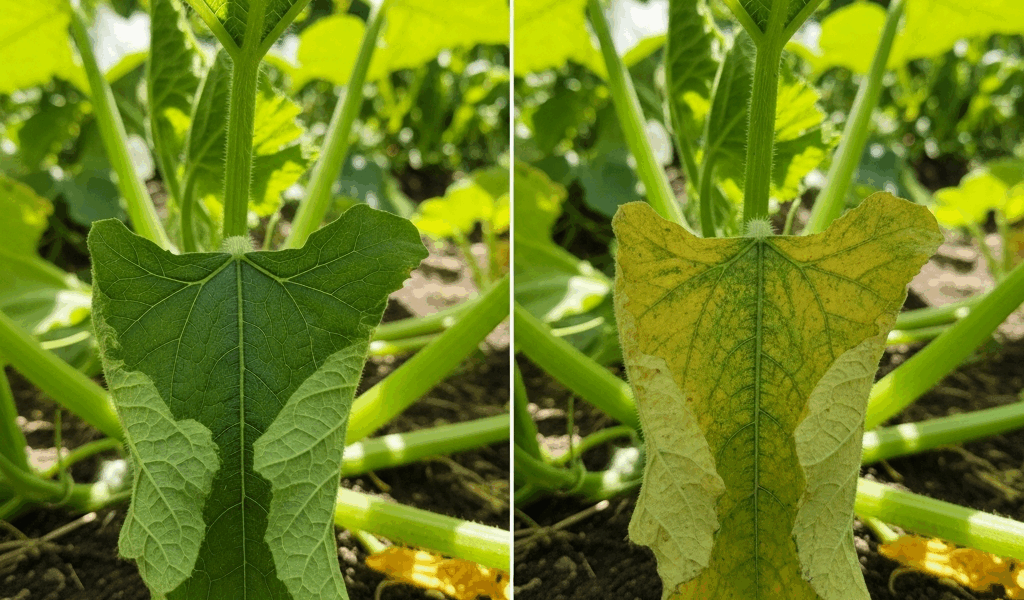
Why Squash Leaves Curl Downward
Squash leaf curl has gotten complicated with all the conflicting advice flying around. You walk out for your morning garden check, spot those sad downward-curling leaves, and suddenly you’re convinced the whole bed is doomed. It’s probably not. Most of the time, curling leaves are your plant talking — not dying.
As someone who’s spent the last seven years growing both summer and winter squash varieties, I learned everything there is to know about what those leaves are actually saying. Patty pans, Hubbards, delicata, the occasional experimental cultivar I grabbed at a seed swap — I’ve grown them all and watched their leaves do strange things. Today, I will share it all with you.
The real culprits break into three buckets: heat and water stress, sap-sucking insects like aphids and spider mites, and viral diseases like squash mosaic virus. Most gardeners are dealing with the first one. Some need pest management. A small percentage face viral issues that honestly require plant removal. So, without further ado, let’s dive in.
Check for Heat and Water Stress First
Start here. Seriously — just start here.
But what is heat stress curl, exactly? In essence, it’s a protective response where leaves curl downward and inward to shrink their sun-exposed surface area. But it’s much more than that — it’s the plant actively managing its own water loss through transpiration, making a split-second survival calculation every afternoon when temperatures peak.
The timing tells you everything. Limp, curled leaves at 2 PM that look completely normal by 7 AM the next morning? That’s heat and water stress, full stop. The plant isn’t collapsing. It’s thirsty. I ignored this pattern for two full seasons and kept overcomplicating my diagnosis. Don’t make my mistake.
Here’s what to actually do:
- Water deeply 2-3 times per week — not daily shallow watering. Target 1-2 inches per week depending on your climate and how much rain you’re actually getting.
- Water before 7 AM if you can manage it. Full tank before the afternoon heat hits.
- Mulch around the base with 2-3 inches of straw or wood chips. Keeps soil temperatures down, cuts evaporation significantly.
- If temperatures spike above 90°F, a 30% shade cloth over the plants during afternoon hours works without sacrificing too much light for fruit development.
I’m apparently a drip irrigation convert now — a $85 kit from my local hardware store, set to 6 AM every other day, and stress curl basically disappeared from my beds. The timer is the part that matters. Consistency beats volume every time.
Look Closely for Aphids or Spider Mites
Leaves curl but stay firm? Don’t bounce back after morning watering? Move to pest inspection. This is the second stop on the diagnostic route, not the first — though plenty of gardeners jump straight here and miss the simpler answer.
Flip a leaf. Look at the underside. Aphids — tiny green or black clusters, sometimes almost dusty-looking — congregate there, especially near new growth at the shoot tips. Spider mites are smaller still, nearly invisible without a magnifying glass, and they leave fine silky webbing stretched between leaves. That webbing is your clearest tell.
Both feed on plant sap. That feeding weakens leaf tissue and triggers the downward curl. You’ll also find sticky honeydew residue on the leaves — sometimes on the soil surface directly below the plant. That residue attracts sooty mold, which shows up as black dusty patches. Not pretty. More importantly, not good for the plant.
Inspect in early morning. Afternoon checks miss a lot — pests hide or become less visible as temperatures climb.
Start mechanical. A strong blast of cool water from the hose directly at leaf undersides removes most aphids and mites without any product at all. Do this before 9 AM, repeat every 2-3 days for a week. That alone clears moderate infestations more often than people expect.
Reinfestation after that? Neem oil might be the best option, as squash pest management requires something that disrupts the life cycle rather than just knocking down visible adults. That is because aphids especially reproduce fast — you’re not just treating what you see, you’re interrupting what’s coming. I use Bonide neem oil concentrate, mixed per the label, sprayed every 7-10 days. Three applications usually handles it. Morning application only — spray above 85°F and you’ll burn the leaves worse than the mites did.
Curling With Mottled or Distorted Leaves May Be Viral
Probably should have opened with a warning on this section, honestly. This is the scenario nobody wants to land in.
Squash mosaic virus and cucumber mosaic virus both cause leaf curl — but paired with other specific symptoms. Yellow-green mottling across the leaf surface. Puckered, warped texture that looks almost contorted rather than simply drooped. Stunted or deformed fruit. The curl from viral infection is tighter, stranger-looking than heat stress curl. You’ll notice the difference once you’ve seen both.
There is no cure. No spray, no amendment, no treatment reverses a viral infection once it’s established. That’s the hard truth of this category.
Your response is twofold. First, remove the infected plant entirely — dig it out, bag it, put it in the trash. Not the compost pile. Wash hands and tools with a 10% bleach solution before touching anything else in the garden. Viral particles travel on hands and equipment more efficiently than most gardeners realize.
Second, go after the aphids. Aphids vector these viruses between plants. Catching aphid populations early — ideally with row covers over young squash before they flower — is genuinely your best line of defense against viral spread to neighboring plants.
Never save seed from infected plants. I’m apparently still bitter about the season I saved seed from what I thought was a drought-stressed plant. Half my seedlings the following spring showed mosaic symptoms right out of the gate. That was 2021, and I still think about it. That mistake cost me an entire early-season planting.
How to Keep Squash Leaves Healthy Going Forward
Prevention beats diagnosis every time — and it’s genuinely less work.
Consistent deep watering on a schedule. Drip irrigation or soaker hoses if you can swing the upfront cost. Plants spaced at least 18-24 inches apart — more in humid regions — so air circulates and morning dew dries before it causes problems. Row covers (floating row fabric, not shade cloth) from transplant until flowers open. That’s what makes row covers endearing to us squash growers: they block roughly 90% of early aphid pressure without blocking sun or rain. Simple, cheap, effective.
Once flowers open and pollinators arrive — usually mid-summer depending on your zone — pull the row covers off. Squash needs bees. No negotiating on that one.
Scout leaf undersides weekly. New growth especially. Early intervention stops an infestation from becoming an epidemic, and it takes about three minutes per bed.
Here’s the bottom line. Most squash leaf curl is fixable, and the fix is usually simple: water it, shade it, or spray the undersides with a hose. Heat and water stress resolves with consistent irrigation. Pest infestations respond to water sprays and a few rounds of neem oil. Only viral infections are permanent — and they’re also the rarest outcome. Start with water and shade. Work your way down the list from there.
If curling is accompanied by loss of green color, use our yellow squash leaf diagnostic guide to check water, nutrients, mites, mildew, bugs, borers, wilt, and viruses.



Stay in the loop
Get the latest the gardening nook updates delivered to your inbox.