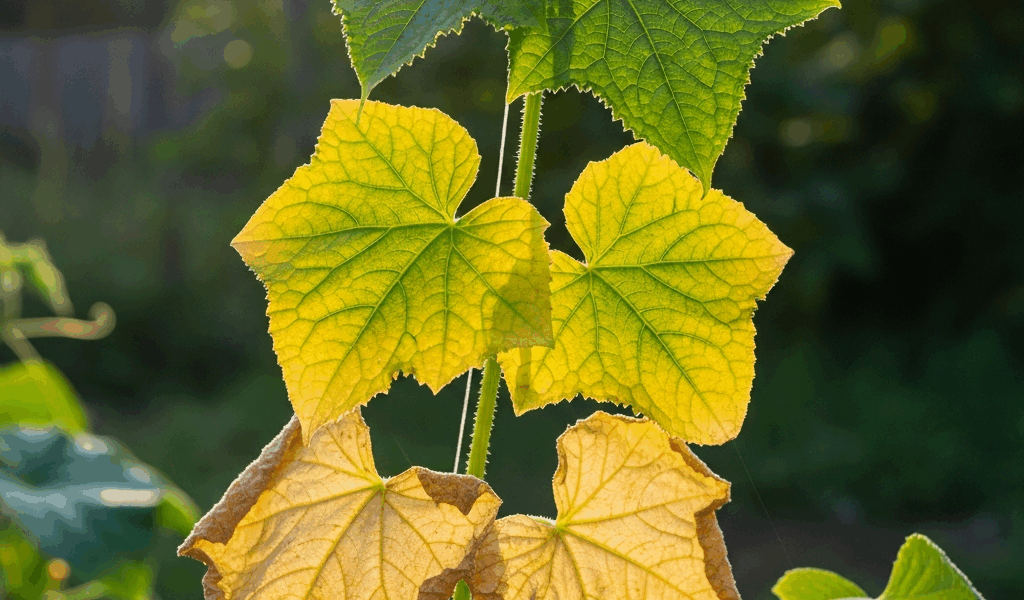
What Part of the Plant Is Yellowing First
Cucumber leaves turning yellow has gotten complicated with all the conflicting advice flying around. That’s the question I get asked most during summer — usually from someone standing in their garden holding a phone and squinting at a leaf like it personally offended them. But before you panic and start spraying everything with sulfur, actually look at where the yellowing is happening.
Location tells you almost everything. Seriously.
Bottom leaves going yellow first? Probably fine. As cucumbers mature, they shed their oldest foliage — the leaves closest to the soil that are just past their prime. This happens whether you’re doing everything right or not. I spent three summers convinced I was killing my plants before realizing I was watching normal senescence. Those lower leaves are often shaded by newer growth anyway, so the plant naturally stops investing in them. That’s what makes cucumber growing endearing to us gardeners — there’s always something new to misread.
But yellowing that spreads upward, starts on new growth at the top, or shows up across the whole plant simultaneously? Something is actually wrong. That’s your signal.
Look at the pattern too. Uniform pale yellow across entire leaves is a completely different problem than mottled yellow with green patches, or yellow between the veins while the veins stay green. Get your face close to the leaf. Use your phone’s macro setting if you have one — mine is the 0.5x wide lens on a Pixel 7, and it’s changed how I diagnose everything out there.
Location plus pattern. That’s your diagnostic key. Use it before you do anything else.
Overwatering and Drainage Problems
Overwatering causes more cucumber problems than anything else. Hands down. I killed more plants with kindness than I ever did with neglect — and I was neglectful plenty of times, trust me.
Cucumber roots sitting in soggy soil literally cannot absorb nutrients properly, even when those nutrients are present. Waterlogged soil excludes oxygen, and roots need to breathe. The plant yellows from nutritional starvation while technically drowning. Counterintuitive and genuinely frustrating the first time you encounter it.
Overwatered leaves look pale and washed-out. They yellow uniformly, often starting at the bottom, and feel soft or limp rather than crisp. The soil stays wet days after your last watering. Sometimes the whole vine just… gives up.
Underwatered leaves look different — yellowing from the edges inward, turning papery and crispy. The plant wilts during the hot part of the day. Easier to spot because the stress is immediate and obvious.
The fix: stick your index finger two inches into the soil near the plant’s base. If it feels wet or even very moist, you’re watering too often. Water deeply but less frequently — once or twice weekly depending on rainfall and heat. Let that top inch dry out between sessions.
If you’re in-ground with clay-heavy soil, you’re fighting uphill. Raised beds drain better — I switched to 12-inch cedar raised beds in 2021 and haven’t looked back. You can amend heavy clay with compost, but it’s slow work. A 3-inch straw mulch layer helps regulate moisture without adding standing water. Not wood chips — they hold too much moisture and create their own problems.
Nutrient Deficiencies That Turn Leaves Yellow
Three specific nutrient problems cause yellowing, and you can actually tell them apart just by looking. So, without further ado, let’s dive in.
Nitrogen Deficiency
But what is nitrogen deficiency doing to your cucumber? In essence, it’s starving the plant of its primary growth fuel. But it’s much more than that — it shows up in a very specific pattern you can learn to recognize.
Uniform pale yellow starting on the oldest leaves — bottom of the plant — moving upward if untreated. The whole leaf turns yellow, not just parts. Cucumbers are nitrogen hogs, especially once they start flowering and fruiting.
Fix: side-dress with compost. I use about 2 inches worked into the soil around the base, staying 4 inches away from the stem. Water it in well. Expect improvement within two weeks. Want faster results? Fish emulsion every 10 days. Not glamorous, but it works — roughly one cup per plant, diluted per the label. Neptune’s Harvest 2-3-1 is what I keep in my garage.
Magnesium Deficiency
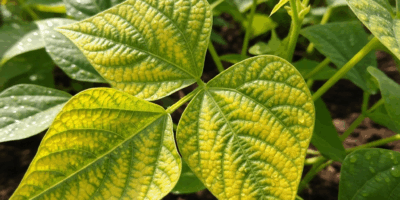
Magnesium deficiency looks specific. Veins stay green while the tissue between them turns yellow — it starts on older leaves, lower foliage first. Not random across the plant. Once you see it, you can’t unsee it.
Fix: Epsom salt spray. Dissolve one tablespoon in one gallon of water. Spray the leaves in early morning or late evening, getting the undersides especially. Every two weeks for two months. This works faster than soil amendments because magnesium absorbs directly through the leaf surface. I saw results in five days the first time I tried it. Don’t make my mistake of waiting three weeks before trying the foliar route.
Iron Deficiency
Iron deficiency yellows the newest leaves while older foliage stays dark green. The veins themselves go greenish-yellow while the tissue between them goes pale. Happens most often in alkaline soil — the iron is present, but the plant can’t access it.
Fix: lower the soil pH. In-ground beds benefit from sulfur worked in before planting. Mid-season, a chelated iron foliar spray helps immediately — Ironite works, so does Hi-Yield Chelated Liquid Iron. But address the pH for long-term success. Get a soil test. Your local extension office charges $15–30 and tells you exactly where your pH sits. Worth every dollar.
Pests and Disease to Check For
Probably should have opened with this section, honestly — pests are the thing gardeners most often forget to check when leaves start yellowing.
Spider Mites
Flip the leaf over. Tiny dots and fine webbing? Spider mites. They feed on leaf tissue and cause stippled yellowing that looks like someone dusted the leaf with pepper. Starts as yellow specks and spreads into larger blotches fast.
They thrive in hot, dry conditions — apparently I’m a perfect spider mite host because my south-facing beds run dry every August and mites find me every single year. Bonide Insecticidal Soap works for me while neem oil never quite does. Spray the undersides every three days for two weeks. Or use a strong water spray from the hose each morning — mites hate humidity.
Cucumber Mosaic Virus
Irregular, mottled yellow patches mixed with green — not uniform color. Leaves look warped or malformed. No cure. Pull the plant and trash it, not the compost pile. Prevent it by controlling aphids, which spread the virus. Choose resistant varieties next year — look for the CMV designation on seed packets.
Downy Mildew
Angular yellow patches bounded by the leaf veins — geometric-looking, almost like someone used a ruler. Undersides develop a gray or purplish fuzzy coating. This is a fungal disease that loves cool, wet conditions. That was 2019 for me. Lost half my row before I understood what I was looking at.
Fix: improve air circulation. Space plants farther apart if you can manage it. Remove infected leaves immediately. Spray with sulfur-based fungicide every 7–10 days starting the moment you see symptoms. Organic growers use sulfur; conventional growers use chlorothalonil. Both work.
How to Fix It and What to Do Right Now
Stop. Breathe. Check in this order.
- Watering first: Stick your finger in the soil. Wet? Back off watering immediately — at least if you want the roots to recover before more damage sets in.
- Look for pests: Flip leaves over. Anything moving or webbing present? Pest problem. Start there.
- Check nutrient status: If the plant is otherwise healthy and the patterns match what’s described above, it’s probably just hungry.
Most cucumbers recover within two weeks of a correct fix. If a plant looks completely wrecked — vines dying back, zero new growth — pulling it and replanting is often faster than saving it. I’ve learned to make that call earlier than feels comfortable.
For next season: mulch heavily from the start. Water on a consistent early-morning schedule only. Rotate your beds — don’t plant cucumbers in the same spot two years running. Disease and pest populations build up in the soil and they will find your plants again.
You’ve got this. Even a plant that looks half-dead often bounces back once you figure out what it actually needs.


Stay in the loop
Get the latest the gardening nook updates delivered to your inbox.