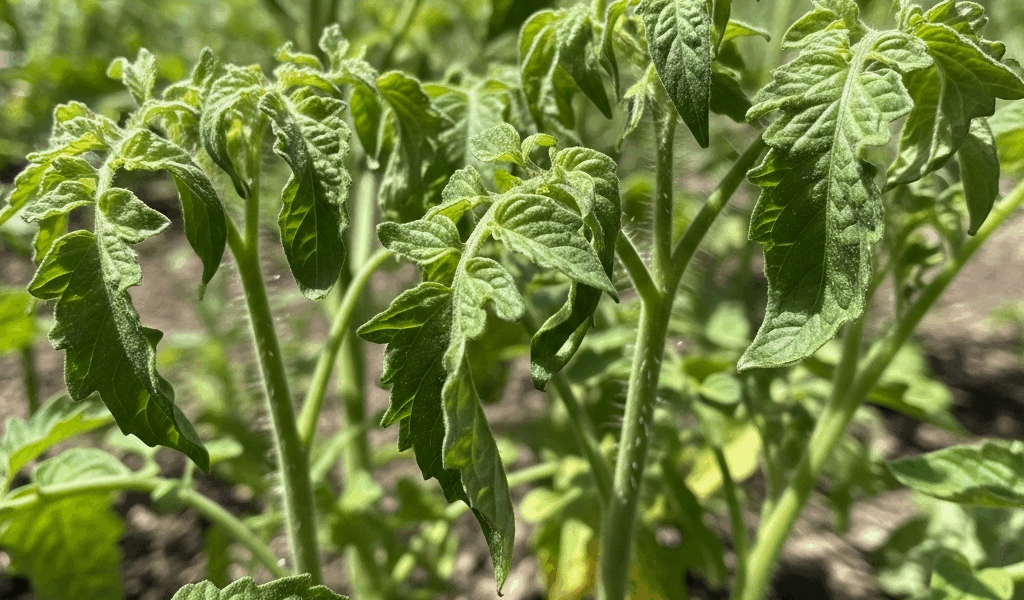
What the Curl Pattern Tells You First
Tomato leaf curl has gotten complicated with all the conflicting advice flying around. And honestly, most of it skips the part that actually matters — the curl itself. Direction, location, timing. That’s your diagnostic entry point, not an afterthought.
As someone who has killed more tomato plants than I care to admit, I learned everything there is to know about reading leaf curl the hard way. Today, I will share it all with you.
But what is leaf curl, really? In essence, it’s your plant talking. But it’s much more than that — it’s a specific language with specific dialects depending on which way the leaf bends.
Upward rolling along the leaf edges: Leaves that curl upward like they’re trying to fold into a taco, starting at the margins and rolling inward. This typically shows up on lower to mid-canopy leaves during the hottest stretch of the afternoon — say, 2 p.m. onward.
Downward cupping or doming: The whole leaf forms a bowl shape, cup-side down, like you’ve pressed your hand against a table. Persists all day. Doesn’t relax in the evening. That distinction matters enormously.
Distorted new growth at the top: Young leaves emerging twisted, mottled, or weirdly stunted. The newest tissue shows damage — not the older, established leaves lower on the plant.
Curling concentrated on lower leaves only: Mature foliage near the soil shows the curl while everything above looks fine. Often comes with yellowing and a visible transition line between affected and healthy growth.
Heat Stress and Physiological Leaf Roll
Here’s probably the most useful thing I learned after growing tomatoes for seven years in zone 6b: most leaf curl in mid-to-late summer isn’t actually a problem. It’s your plant protecting itself.
When temperatures spike above 85°F and your tomatoes are transpiring hard, they roll their leaves upward as a moisture conservation response — reducing surface area exposed to direct sun. It’s not disease. It’s not pest damage. It’s survival strategy, and it works.
I spent an embarrassing amount of money on fungicide sprays one August. Probably close to $60 worth of products I didn’t need. Turns out my ‘Sungold’ and ‘Cherokee Purple’ plants were doing exactly what they should be doing. Don’t make my mistake.
To confirm you’re dealing with physiological leaf roll and nothing else, check for these signals:
- The curl relaxes or disappears completely overnight or in early morning shade
- No yellowing on affected leaves — color stays normal green
- The rest of the plant looks healthy: stems are firm, fruit develops normally, no spots or discoloration anywhere
- Curl appears on lower to mid leaves, not new growth at the top
- The timing aligns with your hottest hours consistently — 2 p.m. to 5 p.m. is the usual window
On watering: deeper, less-frequent watering helps tomatoes build stronger root systems — at least if you want them handling heat stress without drama. A single deep soak to 12–18 inches once or twice weekly beats daily sprinkling. That said, if you’re already watering deeply and the curl relaxes by evening, adding more water won’t prevent it. It’s heat, not drought.
Raised beds dry out faster than in-ground plantings. I’m apparently a chronic under-checker and my Gardena soil moisture meter works for me while finger-testing never gave me reliable readings. Check at 6 inches down. Raised beds in peak summer often need water every 2–3 days. In-ground beds might stretch to 4–5 days depending on your soil texture.
Overwatering or Root Problems Causing Downward Curl
Now swap the curl direction — because downward cupping tells a completely different story.
Overwatered tomatoes develop roots sitting in waterlogged soil. The root cells can’t function, water pressure inside the leaves goes haywire, and the result is a downward dome shape — often paired with yellowing on lower leaves. Stems might feel soft or slightly hollow. The soil stays wet when you check 2 inches down, even a day after watering.
This happens more often in raised beds. The exposed sides dry the edges while the center stays soggy — creating uneven drainage zones the plant never recovers from cleanly.
The fix depends on your setup. In raised beds, stop watering so frequently. Water only when the soil is dry at 2–3 inches depth. Check that water drains freely from the bottom — if it doesn’t, amend with perlite (I use a roughly 20% perlite mix in my 4×8 Cedar beds) or coarse sand. In-ground, the issue is usually compacted soil or clay. Break up compaction carefully, staying 8–12 inches from the stem, and work in compost or aged bark mulch.
Severely waterlogged roots are trouble because root rot sets in fast. Once the root system is compromised, the plant won’t fully recover even if you dial back watering immediately. That was 2019 for me — lost half my yield on two ‘Big Beef’ plants before I figured it out. Prevention matters far more than cure here.
Viral Infection or Pest Damage That Looks Like Curl
Tomato mosaic virus and broad mite damage can mimic stress-related curl. But what is the real difference? In essence, it’s where the damage shows up and what travels with it. But it’s much more than location — it’s the whole picture the plant is painting.
Tomato mosaic virus: New growth emerges twisted, stunted, or mottled with irregular yellow and green patches. The distortion happens on fresh leaves consistently — not just during hot afternoons. Leaves can feel rough or bumpy under your fingers. Fruit shows spotting or uneven ripening. The curl is almost incidental to the broader distortion pattern.
Tomato mosaic spreads through contact — your hands, tools, clothing. Touched an infected plant and then handled a healthy one? You’ve probably spread it. There’s no chemical fix for viral infections. Your only real option is removing the plant entirely, cleaning all tools with a 10% bleach solution, and washing your hands thoroughly. It’s a brutal call to make, but leaving an infected plant spreads the virus to every neighboring tomato you have.
Broad mite damage: These tiny pests are almost invisible — you need a 10x hand lens to see them — but their damage is distinctive. Affected leaves curl downward and develop a bronze or brownish sheen. New growth looks abnormally small and bunched together. Stems can become brittle. The damage spreads from new growth downward over days, not just appearing during a heat wave.
Broad mites thrive in warmth and humidity. Spray affected plants with insecticidal soap or neem oil every 3–4 days for at least two weeks, hitting the undersides of leaves and new growth where mites hide. If you’re in a region with heavy broad mite pressure, switch to mite-resistant varieties like ‘Defend’ or ‘Iron Lady’ next season.
That’s what makes pattern recognition endearing to us tomato growers — heat stress is temporary and predictable, while viral or pest damage is progressive and keeps getting worse. Check the whole plant, not just the curled leaves.
When to Actually Worry and What to Do Next
Probably should have opened with this section, honestly — it’s the part that actually changes what you do tomorrow morning.
Do nothing if: Leaves curl upward during peak afternoon heat, relax by evening or early morning, stay green, and the plant otherwise looks completely healthy. Normal. Your plant is managing heat stress exactly right. Walk away.
Act if any of these are true:
- The curl persists through morning and evening — not just midday
- Yellowing spreads from lower leaves upward over a week or more
- New growth at the top emerges twisted or mottled, not just curled
- Stems feel soft, mushy, or slightly hollow when you gently squeeze them
- A bronze sheen or unusual discoloration appears on curled leaves
For persistent downward curl with yellowing, adjust your watering immediately. Let soil dry to 2 inches before the next watering. In a raised bed, verify drainage is actually working at the bottom — pull out the bottom drain plug or check for pooling. Give it one week. If the curl doesn’t improve and yellowing accelerates, you’re likely dealing with root rot. Pull the plant, replace the soil in that spot, and don’t replant tomatoes there next year.
For distorted new growth, check stems and leaf undersides with a hand lens for tiny pests. See nothing but the distortion pattern is unmistakable? Assume viral infection and remove the plant. Don’t wait on this one. Infected plants don’t recover — they just spread.
For heat-related curl alone, stay consistent with deep watering and mulch the soil surface with 2–3 inches of wood chips or straw. This moderates soil temperature and slows moisture loss considerably. I’m apparently a mulch fanatic at this point and my Oldcastle Premium Wood Chips work well for me while straw mulch never stayed put in my raised beds. Your plant will curl less across the rest of the season even during serious heat events.
Not every curl is a crisis. Most of it is your tomato plant saying “It’s hot and I’ve got this.” Knowing the difference between that and an actual problem saves real money, real time, and plants you don’t have to lose.




Stay in the loop
Get the latest the gardening nook updates delivered to your inbox.