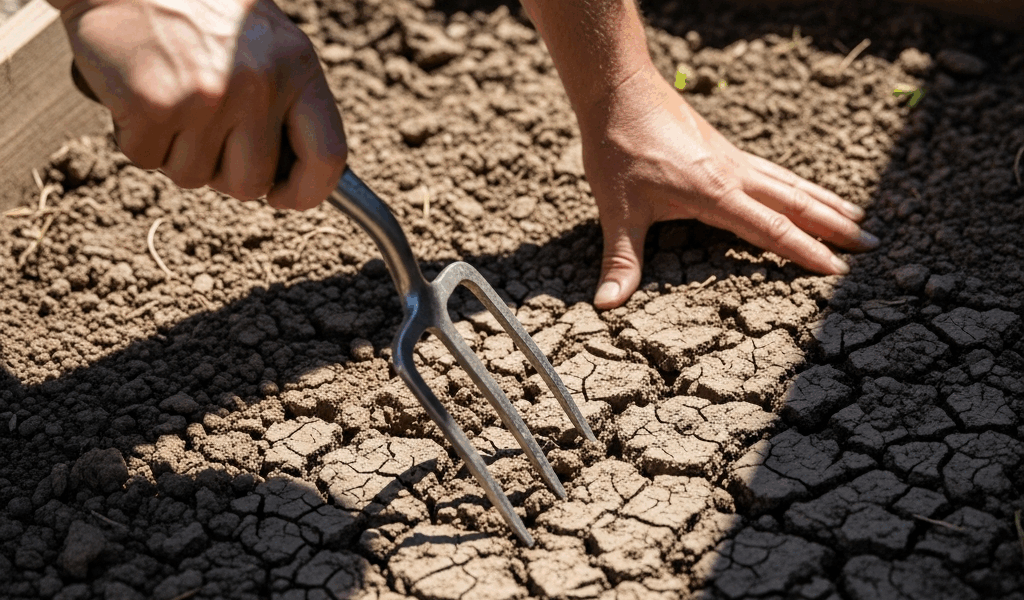
The soil in your raised bed was loose and fluffy when you built it. Now, two or three seasons later, it feels like you are trying to dig in modeling clay. The surface is cracked. Water pools on top instead of soaking in. Your plants look stressed even though you are watering and feeding on schedule. The soil compacted, and fixing it is simpler than you think — but the solution depends on whether you are mid-season or between seasons.
Why Raised Bed Soil Gets Compacted
Raised bed compaction has different causes than regular garden soil compaction, and understanding them saves you from applying the wrong fix.
The biggest one is organic matter decomposition. If you filled your beds with a peat-heavy mix or bagged garden soil, those organic components break down over time. Peat moss in particular compresses dramatically as it decomposes — a bed that started at 12 inches of fluffy peat-based mix can settle to 8 or 9 inches in two years. That two to three inch drop in soil level per year is normal decomposition, not a drainage problem, but the remaining material is denser and more tightly packed than what you started with.
Stepping on the bed is the second most common cause, and the most preventable. Every time you stand in the bed to reach the back row, your body weight compresses the soil structure underneath your feet. Over a season of planting, weeding, and harvesting, the footprint zones become nearly impenetrable. I learned this the hard way with a 5-foot-wide bed I built before I knew better. The outer 18 inches grew great tomatoes. The center strip where I stood to reach them grew almost nothing.
Heavy rain without mulch cover is the third factor. Bare soil in a raised bed takes the full force of downpours. The impact compresses the surface layer and creates a crust that water cannot penetrate — which leads to more pooling, more compression, and a vicious cycle that gets worse each storm.
Finally, if you never add organic matter between seasons, you are essentially mining the soil. Plants extract nutrients and structure from the bed all season long, microorganisms consume organic material, and nothing replaces it. After two or three seasons of this, even a great initial soil mix turns into something resembling concrete.
The Mid-Season Fix — Aerate Without Destroying Roots
If your bed is compacted right now with plants growing in it, you cannot rip everything out and start over. You need to improve the soil without killing what is already growing.
A broadfork is the ideal tool if you have open space between rows. Insert the tines straight down about 8 inches, rock the handle back gently to lift and loosen the soil, pull it out, and move 6 inches over. Work down the row between your plants, staying at least 6 inches away from any plant stems to avoid root damage. One pass with a broadfork makes a dramatic difference in how water penetrates.
For beds where plants are too close together for a broadfork, use a standard garden fork. Push the tines straight down 6 to 8 inches every 6 inches across the bed, then wiggle the handle slightly before pulling up. You are creating channels, not turning the soil. Do not twist or lever — that tears roots. Straight down, slight wiggle, straight up.
After aerating, top-dress with an inch of finished compost between and around the plants. Water it in gently. The compost will work into the aeration channels over the next few watering cycles, feeding the soil biology that creates long-term structure. Then mulch on top of the compost with 2 inches of straw or shredded leaves — this prevents the surface from crusting up again between rains.
Do not rototill an established raised bed. Ever. Tilling destroys the mycorrhizal fungal networks that your plants depend on for nutrient uptake, chops up earthworms that are doing aeration work for free, and actually makes compaction worse in the long run by creating a hard pan layer just below the till depth.
The Seasonal Refresh — Rebuilding Soil Structure
Between seasons — after you pull spent summer plants or before spring planting — is when you can do the real renovation work.
Start by removing any remaining plant debris and pulling mulch to the side. Use a broadfork to work the entire bed, going in rows 6 inches apart across the full width. This time you can be more aggressive since there are no roots to protect — rock the handle fully back to lift and fracture the compacted layers.
Now add amendments. The ratio that has worked consistently across my beds over multiple seasons: 60 percent existing soil (what is already in the bed), 25 percent finished compost, and 15 percent perlite or coarse horticultural vermiculite. The perlite is the critical ingredient most people skip — it creates permanent air pockets that resist compression. Unlike organic matter, perlite does not decompose, so those air channels persist season after season.
Fork the amendments into the top 6 to 8 inches of soil. You are blending, not tilling — the goal is integration, not destruction of existing soil layers. Once blended, level the surface with a rake and top with 2 to 3 inches of mulch for winter. Shredded leaves are ideal because they break down slowly and feed the soil biology over the dormant months.
If your bed has lost significant volume (dropped 3 or more inches from the original level), add enough fresh material to bring it back up. A 50/50 mix of compost and the garden soil/perlite blend works well for filling. Resist the urge to use straight bagged garden soil — most of it is peat-heavy and will compress back down within a year.
Preventing Compaction Going Forward
The single most impactful prevention measure is never stepping in the bed. Design or retrofit your beds to be no wider than 4 feet — this lets you reach the center from either side without climbing in. If you have an existing wide bed you cannot rebuild, lay a board across the top as a temporary bridge when you need to reach the middle. The board distributes your weight across a larger area, dramatically reducing point compression.
Mulch every bed, every season, year round. Two to three inches of organic mulch protects the surface from rain impact, regulates temperature, holds moisture, and feeds the soil organisms that maintain structure. Bare soil in a raised bed is a compaction accelerator.
Add compost every season — spring and fall if you can manage it. Even a single inch of fresh compost twice a year keeps the organic matter level high enough that soil biology stays active and aeration happens naturally through earthworm activity and microbial processes.
Plant cover crops in beds that would otherwise sit empty over winter. Crimson clover and winter rye are the standard choices. Their roots physically break up compacted layers as they grow — essentially doing broadfork work for free, 24 hours a day, all winter long. In spring, cut them at the base, leave the roots in place to decompose (they become organic matter and aeration channels), and plant right through the mulched stems.
Avoid pure peat-based soil mixes when filling or topping up beds. Peat compresses severely when it dries out and becomes hydrophobic — water runs off dry peat instead of soaking in, which is the opposite of what you want. A mix that includes perlite, compost, and some topsoil holds its structure far better over multiple seasons than any pure peat formulation.


Stay in the loop
Get the latest the gardening nook updates delivered to your inbox.