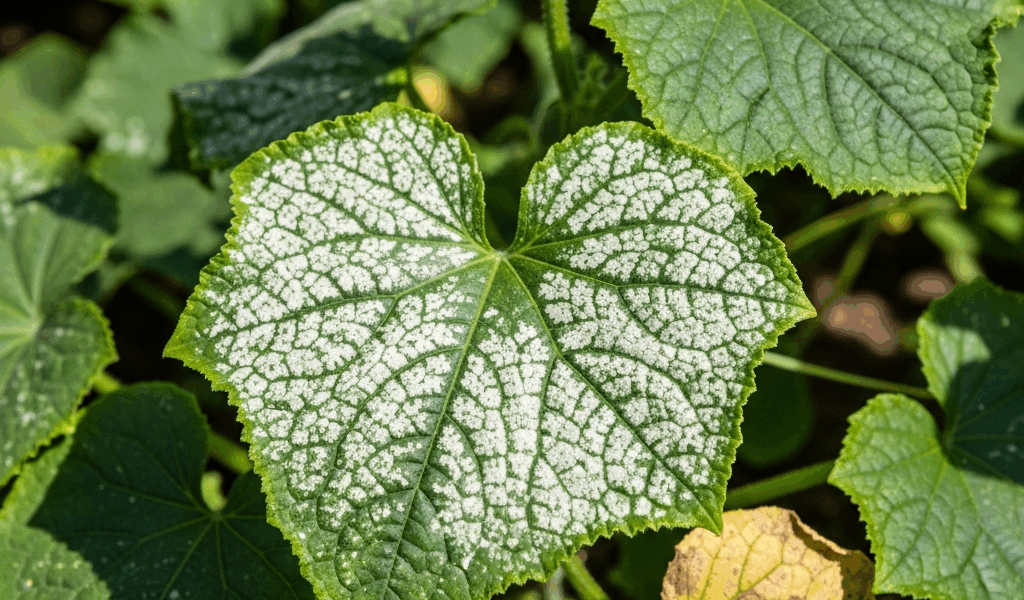
Something is happening to your cucumber leaves and they are turning white. The question that matters right now is whether you are dealing with powdery mildew — a fungal disease that will spread to every plant in the bed if you ignore it — or plain sunburn, which looks alarming but stops on its own. The two problems look similar from across the garden but are completely different up close, and treating one when you have the other wastes time and money.
Powdery Mildew or Sunburn — How to Tell the Difference
Powdery mildew starts as small circular white spots, usually on the lower and older leaves first. Those spots have a dusty, talcum-powder texture — if you run your finger across one, it smears. Over the course of a few days, the spots expand and merge until entire leaf surfaces look like someone dusted them with flour. Mildew typically shows up when temperatures sit between 68 and 81 degrees Fahrenheit with moderate to high humidity. It does not need wet leaves to take hold, which catches a lot of gardeners off guard. And it spreads — from leaf to leaf, plant to plant, and across your entire cucurbit family if conditions stay favorable.
Sunburn is a different animal entirely. You will see bleached, pale, or silvery patches concentrated on the upper sides of leaves — specifically the leaves that face direct afternoon sun. Sunburned patches feel papery and dry, not powdery. The damage does not spread from one leaf to another because it is not caused by a living organism. It is a stress response that happens when temperatures spike above 90 degrees, when seedlings get transplanted without hardening off, or during a sudden heat wave after a cloudy stretch. If you moved your cucumber starts outdoors last week and the tops of the leaves look white, that is almost certainly sunburn, not disease.
The quick diagnostic: rub the white area with your thumb. If it smears like chalk dust, you have mildew. If it feels dry and papery and nothing transfers, it is sun damage. That ten-second test saves you from spraying fungicide on a plant that just needs shade.
Treating Powdery Mildew on Cucumbers
If the rub test confirmed mildew, act fast. The fungus spreads quickly once established and will eventually kill the leaves it colonizes, reducing your harvest significantly.
Neem oil spray is the first line of defense for most organic gardeners. Mix according to label directions — typically 2 tablespoons per gallon of water with a few drops of dish soap as an emulsifier. Spray the tops and undersides of all leaves, not just the infected ones. Apply in the early morning or evening, never in direct sun, because neem oil plus intense sunlight will burn the leaves worse than the mildew did.
The milk spray trick actually works, and I was skeptical until I tried it. Mix whole milk and water at a 40/60 ratio, spray it on the leaves every week. The proteins in milk interact with sunlight to create a mild antiseptic effect on the leaf surface. Multiple university studies have confirmed it is effective against powdery mildew specifically. It sounds ridiculous. It works.
Baking soda solution serves as a preventive more than a cure. One tablespoon of baking soda per gallon of water with half a teaspoon of liquid dish soap. Spray weekly on uninfected leaves to create an alkaline surface that discourages spore germination. It will not eliminate an active infection but slows the spread while your neem oil treatments do the heavy work.
For severe infections where more than half the leaves are covered, a sulfur-based fungicide is the nuclear option. Follow label rates carefully — sulfur can damage plants in temperatures above 90 degrees, so apply on cooler days only.
Prevention is easier than treatment. Space cucumber plants at least 36 inches apart for airflow. Water at the base with drip irrigation or a soaker hose — wet leaves in humid conditions are an invitation. If you are growing vertically on a trellis, mildew pressure drops dramatically because air circulates around every leaf instead of stagnating in a ground-level tangle.
Fixing Sunburn Damage
The hard truth about sunburn is that you cannot reverse existing damage. Those bleached patches will not turn green again. But here is the thing most people get wrong: sunburned leaves still photosynthesize through their undamaged sections. Do not yank them off unless the entire leaf is crispy and brown. A leaf that is 60 percent healthy is still feeding the plant — removing it reduces the plant’s total energy production for no benefit.
What you can do is prevent more damage. A 30 to 40 percent shade cloth suspended above the plants during the hottest afternoon hours — roughly noon to 4 PM — cuts the heat stress without starving the plants of the morning light they need. Shade cloth costs about $15-25 for a raised bed setup and lasts multiple seasons.
If the sunburn happened right after transplanting, you skipped the hardening-off step. Next time, move seedlings outdoors for increasing periods over 7 to 10 days — starting with 2 hours of morning sun, adding an hour each day — before planting them permanently. That gradual transition lets the leaf cells build up protective compounds that prevent burning.
Morning watering also helps. Plants that are well-hydrated before the afternoon heat handle the stress better than plants that enter the hot part of the day already thirsty. Water deeply at the base before 9 AM, mulch to hold moisture, and the foliage will cope with heat it could not handle when dry.
Preventing Both Problems Next Season
You can knock out both powdery mildew and sunburn risk with the same set of practices. Plant mildew-resistant cucumber varieties — Marketmore 76 is the classic choice and widely available. Space plants at 36 inches minimum. Use drip irrigation at the base, never overhead watering. Mulch with 2 to 3 inches of straw to keep soil temperature stable and moisture consistent.
For a clever dual-purpose trick, plant a row of sunflowers on the southwest side of your cucumber bed. By midsummer they provide natural afternoon shade that protects against sunburn while the morning and midday sun still reaches the cucumbers fully. The sunflowers also attract pollinators, which your cucumbers need for fruit set. One planting solves two problems and looks good doing it.
Trellis your cucumbers if you possibly can. Vertical growing improves airflow around every leaf, reducing mildew pressure. It keeps fruit off the ground. And it makes the white-spot diagnostic easier because you can actually see every leaf without crawling through a vine jungle on your knees.



Stay in the loop
Get the latest the gardening nook updates delivered to your inbox.