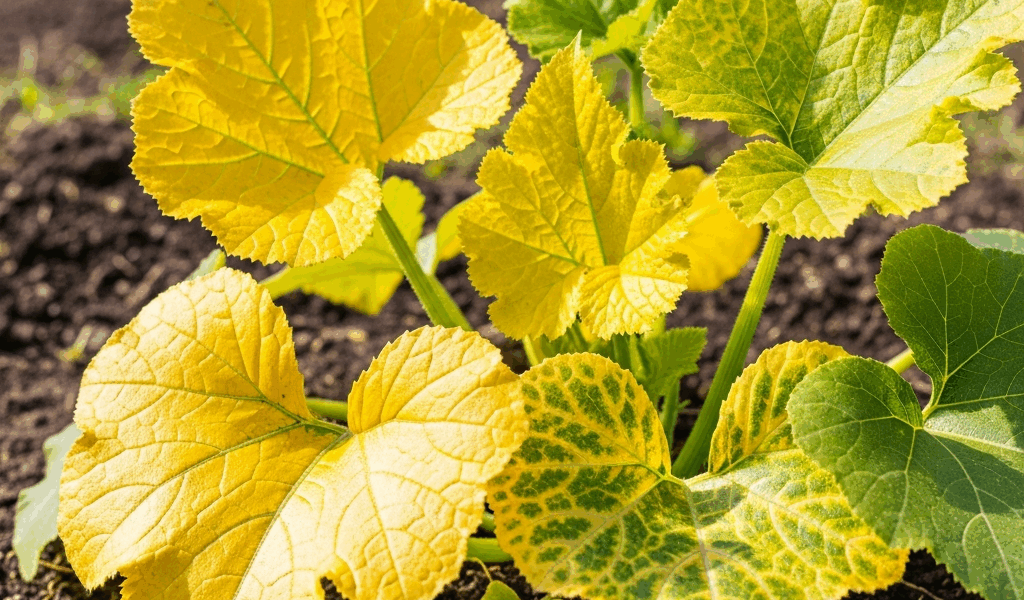
Yellow squash leaves are a symptom, not a diagnosis. One old lower leaf may be normal aging. Whole-plant yellowing can follow saturated roots, drought, or a nutrient problem. Fine speckling suggests mites; angular yellow spots suggest downy mildew; white powder suggests powdery mildew; and sudden wilt with damage at the stem base can indicate squash vine borer.
This guide covers summer squash, yellow crookneck and straightneck squash, acorn squash, butternut squash, and other winter squash. If the plant is specifically zucchini or courgette, use our separate zucchini leaf-yellowing guide for that crop.
Match the pattern before treating
| Symptom pattern | Likely possibilities | What to inspect |
|---|---|---|
| Only one or two old bottom leaves turn evenly yellow | Normal aging or shading | Healthy new growth, firm stems, no spread |
| Many leaves pale; soil remains wet | Root oxygen stress, drainage problem, or root disease | Moisture several inches down, drainage, root/crown condition |
| Older leaves yellow first; plant grows slowly | Possible nitrogen shortage or impaired uptake | Water first, then soil pH and laboratory nutrient test |
| Yellow tissue between greener veins | Nutrient availability, pH, or root stress | Soil test; do not assume magnesium from appearance alone |
| Tiny pale dots, bronzing, or fine webbing | Spider mites | Leaf undersides with a hand lens |
| Angular yellow patches bounded by veins; gray-purple growth below | Downy mildew | Undersides early in the morning; local disease reports |
| White powdery patches that expand | Powdery mildew | Actual surface growth, not natural silver leaf markings |
| Mottled yellow-green, puckered leaves and distorted fruit | Possible mosaic virus | Several leaves and fruit; confirm through Extension diagnostics |
| Sudden wilt; hole and sawdust-like frass at crown | Squash vine borer | Lower stems and crown |
| Wilt despite adequate moisture; cucumber beetles present | Possible bacterial wilt on susceptible cucurbits | Beetles, stem test, and diagnostic confirmation |
When yellow lower squash leaves are normal
A vigorous squash vine may retire old leaves that are shaded beneath newer growth. Normal senescence usually stays near the base and does not come with rapid wilt, spots, distorted new leaves, a soft crown, or poor fruit development.
Leave functional green tissue in place. Remove a leaf when it is mostly dead, badly diseased, or lying on wet soil. Cut the petiole with clean pruners without nicking the main vine. If disease is possible, sanitize the tool before moving to another plant and remove debris according to local disease guidance.
Water and drainage problems
Squash needs consistent moisture, but roots also need air. In saturated soil, roots cannot function normally and the canopy may yellow or wilt even though water is abundant. Severe drought can produce similar wilt followed by yellowing or scorched margins.
- Check the soil several inches deep and a short distance from the crown—not just the dry surface.
- If it is saturated, stop automatic irrigation and identify why water is collecting. Do not cultivate deeply around an established root system.
- If it is dry at root depth, water slowly at soil level so the root zone is moistened rather than briefly wetting the surface.
- Recheck before watering again. Weather, soil, mulch, plant size, and container volume make a fixed daily schedule unreliable.
Keep mulch a little away from the crown and make sure containers drain freely. Correct chronic drainage between crops with a better location, raised bed, or site-appropriate soil improvement. See our vegetable-garden watering guide for a measurement-based approach.
Can nutrients make squash leaves yellow?
Yes, but visual symptoms overlap. Nitrogen deficiency commonly begins on older leaves because the plant can move nitrogen to new growth. Interveinal chlorosis can involve other nutrients, unsuitable pH, root damage, or water stress. Fertilizer cannot repair roots deprived of oxygen, stop a vine borer, or cure a virus.
Correct water problems first. Then test the soil through a university or accredited laboratory and follow its crop-specific recommendation. Do not apply Epsom salt automatically: it supplies magnesium and sulfur, not nitrogen, and unnecessary salts can create another problem. Avoid repeated high-nitrogen feeding late in the season; excessive foliage is not the same as a healthier or more productive vine. Our fertilizer guide explains soil testing and label use.
Downy mildew: angular yellow spots
Downy mildew of cucurbits produces pale green to yellow lesions that are often angular because leaf veins limit their spread. In humid conditions, dark gray to purplish growth may appear on the undersides. Lesions can merge, turning leaves brown and reducing the plant’s ability to support fruit.
Downy mildew is not the same disease as powdery mildew and requires different management. Check regional alerts because its arrival and severity vary. Improve airflow, avoid unnecessary leaf wetness, remove badly affected tissue where practical, and use only a fungicide labeled for downy mildew on the exact edible squash crop. Preventive timing matters. The University of Minnesota Extension downy mildew guide explains symptoms and management.
Powdery mildew: white growth followed by yellowing
Powdery mildew begins as white powdery spots that expand across leaf surfaces and stems. Infected leaves can yellow, brown, and die. Some squash varieties naturally have silver markings that follow the veins; those markings are part of the leaf and do not spread like fungal growth.
Choose resistant varieties when available, provide spacing, remove crop debris, and follow a crop-labeled fungicide program if control is needed. Products work better before disease covers most of the canopy. Avoid improvised dish-soap mixtures that can injure leaves. See the University of Minnesota Extension powdery mildew guide.
Spider mites and squash bugs
Spider mites create fine pale stippling that can progress to bronzing and yellowing. Look underneath leaves for moving dots and silk. A firm stream of water can dislodge mites from leaf undersides; reducing dust and plant stress also helps. If a pesticide is needed, select one labeled for mites on edible squash and protect beneficial insects.
Squash bugs cause yellow spots that later brown, and heavy feeding can wilt leaves or smaller plants. Adults are flattened and brownish; bronze-colored egg clusters occur on leaf undersides, often near veins. Handpick adults and nymphs and destroy eggs on a small planting. Remove hiding places and crop debris. The University of Minnesota Extension squash-bug guide provides identification and control details.
Squash vine borer: inspect the crown
Vine borer larvae feed inside stems and interrupt water movement. Affected vines may wilt suddenly and then yellow. Look for an entry hole, a weakened crown, and tan or orange sawdust-like frass. A plant that wilts every afternoon but recovers overnight may simply be heat-stressed; one with stem damage often continues to decline.
Once larvae are inside, a foliar spray cannot reach them. Prevention—monitoring, egg removal, properly timed row covers, and crop rotation—is more dependable than surgery on an infested stem. Butternut and other Cucurbita moschata squash are often less susceptible than zucchini and many summer squash, but they are not immune. Read the University of Minnesota Extension vine-borer guide and our squash vine borer prevention guide.
Bacterial wilt and cucumber beetles
Striped and spotted cucumber beetles can transmit the bacterium that causes bacterial wilt. Susceptibility differs among cucurbits; cucumbers and muskmelons are often affected more severely than squash, but a rapidly wilting plant with beetle activity deserves investigation.
Cutting and slowly separating a wilted stem may reveal sticky bacterial strands, but home tests are imperfect. There is no cure after a plant is systemically infected. Confirm with a local Extension office or plant diagnostic laboratory, remove confirmed plants, and manage cucumber beetles early with crop-labeled methods. The University of Minnesota Extension bacterial-wilt guide explains the disease cycle.
Mosaic viruses
Mosaic viruses can cause irregular light and dark green or yellow patterns, leaf distortion, stunting, and misshapen fruit. Nutrient problems, mites, herbicide injury, and genetic leaf markings can resemble parts of this pattern, so do not diagnose from one yellow patch.
Viruses cannot be cured by fertilizer or fungicide. Photograph the whole plant and several leaves and contact Extension for diagnosis. Remove a confirmed infected plant, control weeds that may host viruses, and clean tools. Do not save seed from a diseased plant.
What to do today
- Identify the squash: summer squash, butternut, acorn, pumpkin, or another type.
- Map the yellowing: old leaves, new growth, between veins, angular spots, stippling, powder, or mosaic.
- Check soil moisture: determine what is happening at root depth.
- Inspect leaf undersides and stems: look for mites, squash bugs, beetles, mildew, holes, and frass.
- Treat only the confirmed cause: follow laboratory recommendations and crop labels.
- Judge the new growth: damaged leaves may remain yellow even after the problem is corrected.
Frequently asked questions
Is it normal for squash leaves to turn yellow?
One or two old lower leaves can yellow naturally. Rapid spread, new-growth symptoms, spots, wilt, stem damage, or distorted fruit is not normal aging and should be diagnosed.
Should I remove yellow leaves from squash?
Remove leaves that are mostly dead, severely diseased, or lying on wet soil. Keep healthy and partly functional foliage when possible, and avoid damaging the main vine.
Why are butternut squash leaves turning yellow?
Butternut squash can yellow from water or root stress, nutrient problems, mites, squash bugs, downy or powdery mildew, virus, and normal aging. Its tougher stems reduce—but do not eliminate—vine-borer risk.
Will yellow squash leaves become green again?
Often they will not. Recovery is better measured by healthy new leaves, normal fruit development, and yellowing that no longer spreads.


Stay in the loop
Get the latest the gardening nook updates delivered to your inbox.