Why Blueberry Hedges Work — The Dual Purpose
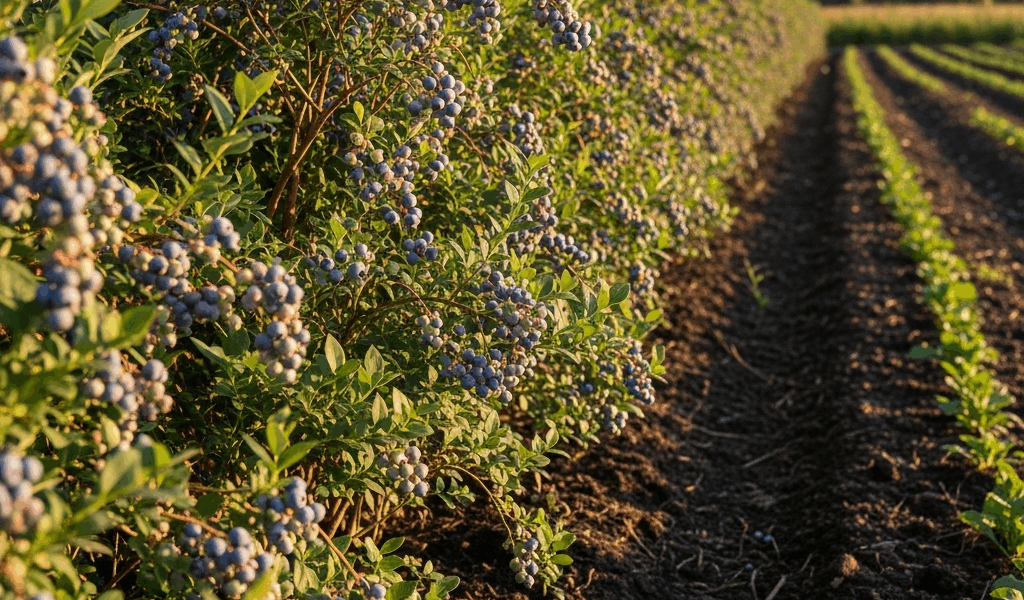
Blueberry hedges have gotten complicated with all the conflicting gardening advice flying around. So let me tell you what actually happened when I planted my first one seven years ago along my property line. I needed privacy screening. That was the whole plan. What I didn’t expect was thirty pounds of fresh fruit every summer landing on top of that. That’s the real thing nobody tells you about blueberry hedges — they solve two completely different problems at once.
Most people think hedges are purely decorative. You plant them, you prune them into neat shapes, you admire them from the patio. But a blueberry hedge does all that while feeding you. The tall, delicate branches carry small white flowers in spring, creating a soft, natural barrier that doesn’t look like a wall. By mid-summer, those flowers become clusters of dusty blue fruit hanging on the branches for weeks.
The year-round visual interest honestly impressed me more than I anticipated. Spring brings those bell-shaped flowers. Summer is obviously about fruit. Fall color is where people really sleep on blueberries though — the foliage goes deep burgundy and orange depending on variety. Even in winter, the branching structure of mature plants adds texture when everything else is dormant and bare.
But what is the one thing that actually makes or breaks all of this? In essence, it’s soil pH. But it’s much more than that. Blueberries have a non-negotiable requirement: acidic soil, specifically a pH between 4.5 and 5.5. Most gardeners never check their soil pH — which is probably why I see so many struggling blueberry plants every spring. I’ll get into how to handle it in the soil prep section. Just know now that it’s the single thing separating a thriving blueberry hedge from a slow, grinding failure.
Best Varieties for Hedging — The Right Cultivar Changes Everything
Probably should have opened with this section, honestly. Variety selection determines whether your hedge gets dense enough for actual privacy screening or stays sparse enough that your neighbors have a clear view of your embarrassing garden shed.
For a standard 5-to-6-foot privacy hedge, highbush blueberries are the right call. Duke, Bluecrop, and Legacy are the workhorses I’ve used repeatedly. Duke ripens early — mid-June for me in zone 6. Bluecrop is the reliable mid-season choice. Legacy pushes into August. These varieties reach 6 feet without looking skeletal. Duke grows the densest of the three, which matters when you’re planting on 3-foot centers and want the gaps filled in by year three.
If you need something shorter — say a 3-to-4-foot border along a walkway — half-high hybrids like Peach Sorbet or North Country are your answer. These are crosses between highbush and lowbush types. Cold-hardy, compact, still productive enough to justify the space. Peach Sorbet has become one of my favorites for smaller properties. The fruit is genuinely good and the plant stays manageable. That’s what makes it endearing to us small-yard gardeners.
In southern zones, rabbiteye varieties like Powderblue and Tifblue handle heat and humidity better than highbush types. I haven’t grown these myself. But I’ve talked to enough gardeners in Georgia and South Carolina to know they’re the correct answer for zones 7 through 9.
Spacing determines whether you get a hedge or just a row of bushes. At 3-foot spacing, you’ll have reasonable density by year four. At 4-foot spacing, it takes a year longer, but individual plants grow larger. I’m apparently a chronic compromiser — I planted my original hedge at 3.5 feet, which drove me slightly crazy while I waited for the canopy to close. Don’t make my mistake. Pick one or the other and commit.
Soil Prep for Blueberry Hedges — The Acid Test
As someone who skipped the soil prep step on my first attempt, I learned everything there is to know about blueberry soil requirements the hard way. Today, I will share it all with you.
Start with a soil test. Get it done through your local cooperative extension office. Mine cost $15 and took two weeks. The report tells you your current pH and your actual soil composition. Most garden soils run neutral around 7.0 or slightly alkaline at 7.5 and above. Blueberries want 4.5 to 5.5. That gap isn’t trivial.
Sulfur amendments lower pH. If your soil sits at 6.5 and needs to drop to 5.0, you’re spreading elemental sulfur at roughly 1.5 pounds per 100 square feet of hedge area. I used Espoma Soil Acidifier — it’s sulfur-based, about $12 per 10-pound bag at most garden centers. Work it into the top 6 inches of soil in fall if possible, letting it sit over winter so microbial activity converts it to sulfuric acid. Planting in spring? Do the sulfur amendment the fall before. That timing matters more than most people realize.
The peat moss planting technique is what actually made my plants thrive. Instead of amending your entire hedge line uniformly, dig individual planting holes and backfill with a custom acidic mix. I used a 50-50 blend of peat moss and composted bark — that combination naturally sits around pH 4.8. Creates an acidic pocket around each plant. Yes, roots eventually push into surrounding soil. But by that point the plant is established and more tolerant of slightly higher pH outside the pocket.
Mulch matters too — and here’s where people go wrong. Pine needle mulch, sometimes called pine straw, is ideal because it naturally acidifies the soil as it breaks down. Wood chips do the opposite; they raise pH slightly as they decompose. I spread pine straw 3 to 4 inches deep around each plant, keeping it about 6 inches back from the stem to prevent rot. A bale of pine straw runs about $6 and covers roughly 20 linear feet of hedge at that depth.
Planting and First Year Care — Getting Roots Into Ground
Spring or fall both work. I’ve had better results with spring planting — the plants get a full growing season to establish roots before facing winter stress. Container plants are the standard nursery option, running $18 to $35 per plant depending on size and variety. They establish faster than bare-root stock. Bare-root plants cost less, though, which matters when you’re planting a 30-foot hedge and doing the math on 10 or 12 plants.
Planting depth is straightforward but easy to miss. The top of the root ball should sit level with the soil surface. Blueberries hate being planted too deep — full stop. I’ve watched people bury the crown thinking it protects the plant, then watched it slowly decline over two years. Shallow is correct here.
Water immediately after planting. First growing season, blueberries need consistent moisture — roughly 1 inch per week through rainfall or irrigation. I set up soaker hoses along the hedge line and ran them on a timer three times weekly. That sounds obsessive, but young plants in amended or sandy soil dry out fast.
Remove the flowers in year one. This is the hard part. Those white flowers want to become berries. The plant needs to invest that energy into root development instead. I’m apparently someone who ignores good advice — I left the flowers on that first summer and got exactly one pound of berries while my plants visibly stressed. Second year, after removing the flowers during year one, I got 8 pounds from the same plants. Don’t make my mistake.
Pruning for Hedge Shape vs Fruit Production — The Annual Balance
Growing a blueberry hedge differs from growing blueberries in a standard berry patch. But what is the core difference? In essence, it’s the pruning strategy. But it’s much more than a simple adjustment — it changes how you think about the plants entirely.
Years two and three: minimal pruning. Let the plants grow tall and wide. Remove dead or crossing branches, but resist the urge to shear the hedge into a crisp shape. You’re waiting for canopy density. Shearing early just delays that.
By year four, the hedge should be closing in. Now you can start managing shape. A natural, slightly rounded approach works better than formal hedging. I use Felco No. 2 hand pruners and maintain a rounded top — wider at the base, narrowing toward the top — which keeps the bottom from getting shaded out and bare. The rounded profile also sheds snow better than a flat top in heavy winters.
Timing is everything. Prune in late winter or very early spring, before growth starts. I prune in late February in my zone. Cut back shoots that have grown beyond the hedge outline, but don’t remove more than one-third of the previous year’s growth. Aggressive pruning reduces berry production proportionally. That’s a direct trade-off, not a gray area.
Here’s the tension you’ll live with every spring: dense, well-shaped hedges produce fewer berries per plant because of the branch removal involved. A loosely maintained hedge produces more fruit but looks less intentional. I’ve landed somewhere in the middle — removing enough to keep a clean outline, leaving plenty of fruiting wood. My hedge sacrifices maybe 20 percent of potential production for the visual structure. That trade-off works for me. It might not work for you, and that’s a real decision worth making before you pick up the pruners.
Blueberry hedges take patience. My hedge didn’t hit its current productive state until year five. That was 2022. Now every summer I stand in front of a legitimate privacy screen eating fresh berries straight off the plant. The dual payoff — privacy and abundance — is worth every frustrating year of waiting for the canopy to close in. So, without further ado, get your soil tested. That’s where everything starts.

Stay in the loop
Get the latest the gardening nook updates delivered to your inbox.