The One Recipe That Works for Everything
Raised bed soil has gotten complicated with all the conflicting advice flying around. Expensive pre-mixed bags. Custom recipes with seventeen ingredients. Guys on YouTube swearing by volcanic rock dust from a specific quarry in New Zealand. I’ve been down every rabbit hole.
This article includes affiliate links. We may earn a commission at no extra cost to you.
As someone who has been filling raised beds for ten years, I learned everything there is to know about getting the soil right. Today, I will share it all with you.
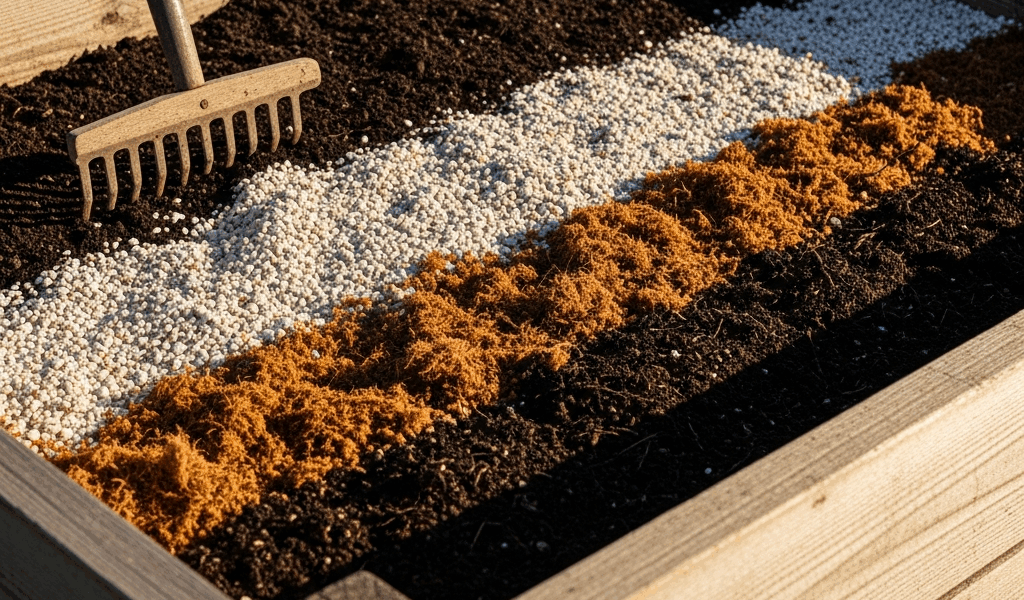
The recipe that actually works — the one I keep coming back to — is almost embarrassingly simple: one-third compost, one-third topsoil, one-third coarse vermiculite or perlite. That’s it. Equal parts, by volume.
This 1-1-1 formula is a streamlined version of what’s sometimes called Mel’s Mix, based on the square-foot gardening method Mel Bartholomew developed decades ago. His original version called for specific materials that weren’t exactly easy to find at your local co-op. What I’m describing here is the tested, refined version — works in zone 5 with lettuce, works in zone 8 with tomatoes, works everywhere in between.
Frustrated by a bed that kept getting heavier and more concrete-like each summer, I once dug out two full cubic feet of dense, compacted material that could barely hold a transplant upright. That’s the moment I stopped eyeballing ratios. Don’t make my mistake.
Why Each Ingredient Matters
Compost — Biology and Available Nutrients
But what is compost, really? In essence, it’s decomposed organic matter. But it’s much more than that. A cubic foot of quality finished compost contains roughly 200 million beneficial microbes. That’s not a metaphor — that’s just biology.
Those microorganisms break down organic matter, unlock nutrients for plant roots, and actively suppress disease. Compost also supplies nitrogen, phosphorus, and potassium in slow-release forms — finished compost typically tests around 1-2% nitrogen by weight. Nothing dramatic. No synthetic spikes. Just steady, consistent feeding your plants can actually use.
Finished compost only, though. Look for dark color, crumbly texture, an earthy smell. Partially broken-down material heats up inside the bed and wrecks seedlings fast. I learned that in year two — watched three full trays of transplants wilt overnight. Not a fun morning.
Topsoil — Structure and Minerals
Topsoil is the mineral backbone of the mix. Sand, silt, clay — in proportions that give soil structure, meaning it holds shape while still letting roots push through. Without it, you’re basically growing in a pile of decomposing organic matter sitting on top of some expanded minerals. Plants can survive that. They don’t thrive.
Topsoil also brings calcium, magnesium, and trace minerals — the stuff that doesn’t show up in compost. It anchors plants physically. It keeps the upper layer from sealing itself off and cutting out airflow.
Buy local when you can. Topsoil from a pit in central Pennsylvania has genuinely different mineral composition than topsoil from Montana — and local sources run $25 to $50 per cubic yard, delivered, versus whatever shipping-inflated bagged stuff costs at the hardware store.
Vermiculite — The Moisture Manager
Here’s the ingredient most recipes mention but never really explain. Vermiculite is a naturally occurring mineral — heated until it expands into a lightweight, porous material with tiny water-trapping pockets. It stays light. It doesn’t compress over seasons. That’s the whole point.
Without it — or without perlite — a compost-and-topsoil blend compacts. Gravity does it. Water pressure does it. By October you’ve got dense, uneven material that’s waterlogged in one corner and bone dry in another. Vermiculite maintains pore space, keeps moisture distribution even, and being inert, it doesn’t break down. The same cubic foot loosening your mix in April is still loosening it come frost.
Coarse vermiculite, not fine. Fine grade is for seed starting — it settles and compacts in outdoor beds. The coarse stuff, sold for gardening use rather than industrial applications, holds its structure. A 4-cubic-foot bag runs $15 to $25 depending on supplier. That’s what makes good drainage endearing to us gardeners who’ve lost plants to root rot before.
Budget-Friendly Substitutions
Probably should have opened with this section, honestly. Cost matters — especially if you’re filling three or four beds at once.
When Vermiculite Gets Expensive
Perlite substitutes perfectly, volume for volume. Also an expanded mineral, also creates air space the same way. The difference? Vermiculite holds slightly more moisture; perlite drains slightly faster. For most vegetables, you genuinely won’t notice. Perlite typically runs $12 to $18 per 4-cubic-foot bag — a little cheaper, widely available.
I’m apparently a vermiculite person and the coarse Espoma brand works for me while perlite never quite feels the same. But that’s a personal thing. Either will do the job.
Some gardeners swear by rice hulls or bark chips as alternatives. I tested rice hulls across two beds over three full seasons. First year — fine. Second year — breaking down noticeably. Third year — compaction was back. Save your money. Stick with vermiculite or perlite.
Coconut Coir Instead of Peat Moss
The original Mel’s Mix called for peat moss. I don’t use it anymore. Peat comes from wetland ecosystems — the extraction process destroys them, and honestly, coconut coir performs just as well and is actually a renewable byproduct of the coconut industry. If you’re working from an older recipe that lists peat moss, swap coir at a 1-to-1 ratio.
Coir needs prep. It comes compressed into bricks — one brick rehydrates into roughly 8 to 10 liters of loose material. Soak it completely before mixing it in. It can run slightly salty straight from the package, so a thorough soaking helps. Bricks cost $3 to $6 each and cover more volume than you’d expect from something that fits in your hand dry.
Municipal Compost and Cost Comparison
Bagged compost from big-box stores runs $4 to $8 per cubic foot. A standard 4-by-8-foot bed at 12 inches deep needs 32 cubic feet of finished mix. At $6 per cubic foot, that’s $192 in compost alone. Three beds — $576, just for one ingredient.
Many municipalities sell finished bulk compost for a fraction of that. My town delivers cubic yards — that’s 27 cubic feet — for $35. Three cubic yards, 81 cubic feet, costs $105 instead of nearly $500. The math shifts fast.
Call your local solid waste management facility or public works department. Ask whether they compost yard waste and sell the finished product. Some programs give it away completely free. That’s how experienced gardeners actually fill beds without going broke. So, without further ado, make that call before you order anything bagged.
Full Cost Breakdown Per Cubic Foot
Using bulk materials and municipal compost:
- Compost from municipal source: $1.30 per cubic foot
- Topsoil from local supplier: $0.90 to $1.20 per cubic foot
- Vermiculite or perlite: $3 to $4 per cubic foot
- Total: $5.20 to $6.50 per cubic foot
Using bagged materials from a garden center:
- Bagged compost: $5 to $8 per cubic foot
- Bagged topsoil: $2 to $3 per cubic foot
- Bagged vermiculite: $3.75 to $5 per cubic foot
- Total: $10.75 to $16 per cubic foot
Bulk saves you 50 to 60% — consistently. Even one 4-by-8 bed makes bulk sourcing worth the extra phone call.
How Much Soil Do You Need?
The math here is simple. Interior length in feet, times width in feet, times depth in feet. That gives you cubic feet.
Length × Width × Depth = Cubic Feet
A 4-by-8-foot bed at 12 inches — 1 foot — of depth needs 32 cubic feet. Same bed at 18 inches needs 48. Depth matters more than most people expect. Most vegetables do fine at 12 inches. Tomatoes, peppers, carrots, anything with serious root mass — go 18 if your budget allows.
Standard Bed Sizes and Volumes
- 4-by-4 at 12 inches: 16 cubic feet
- 4-by-8 at 12 inches: 32 cubic feet
- 4-by-8 at 18 inches: 48 cubic feet
- 3-by-6 at 12 inches: 18 cubic feet
- 2-by-10 at 12 inches: 20 cubic feet
When ordering bulk, confirm units before the truck shows up. Suppliers use cubic yards — 27 cubic feet — as their standard. Some have a one-yard minimum. Others sell half-yards. Know your number going in. Showing up unprepared when a delivery driver is idling in your driveway is a specific kind of stress you don’t need.
Refreshing Soil Each Season
The 1-1-1 mix doesn’t last forever — though it lasts longer than most people expect. Compost keeps breaking down. Roots work through the structure. Water pressure slowly densifies everything. By year two or three, you’ll see the bed settling, the surface sitting lower, the texture going firmer.
Don’t tear the whole thing out. Wasteful, exhausting, unnecessary. Instead, spread 2 inches of finished compost across the surface every spring and work it into the top few inches with a garden fork. Refreshes the biology, restores nutrients, loosens the upper layer. That was 1996 thinking — the full replacement approach. Nobody does it that way anymore.
Do that annually and the bed stays productive more or less indefinitely. After five years you may have effectively replaced most of the original fill — but gradually, cheaply, without a single afternoon of hauling soil bags.
Every third year, a soil test might be the best option — at least if you want to stop guessing about pH and nutrients. That is because extension service labs typically charge only $15 to $40 per sample and tell you exactly what’s off before it shows up as sick plants. High phosphorus? Skip the fertilizer additions that year. pH drifting? You’ll know before seedlings start yellowing for no apparent reason.
Full replacement is only warranted for contamination, persistent disease, or compaction so severe that annual amendments haven’t touched it. For standard home gardening? Add compost every spring. Test every few years. That’s the whole system.



Stay in the loop
Get the latest the gardening nook updates delivered to your inbox.